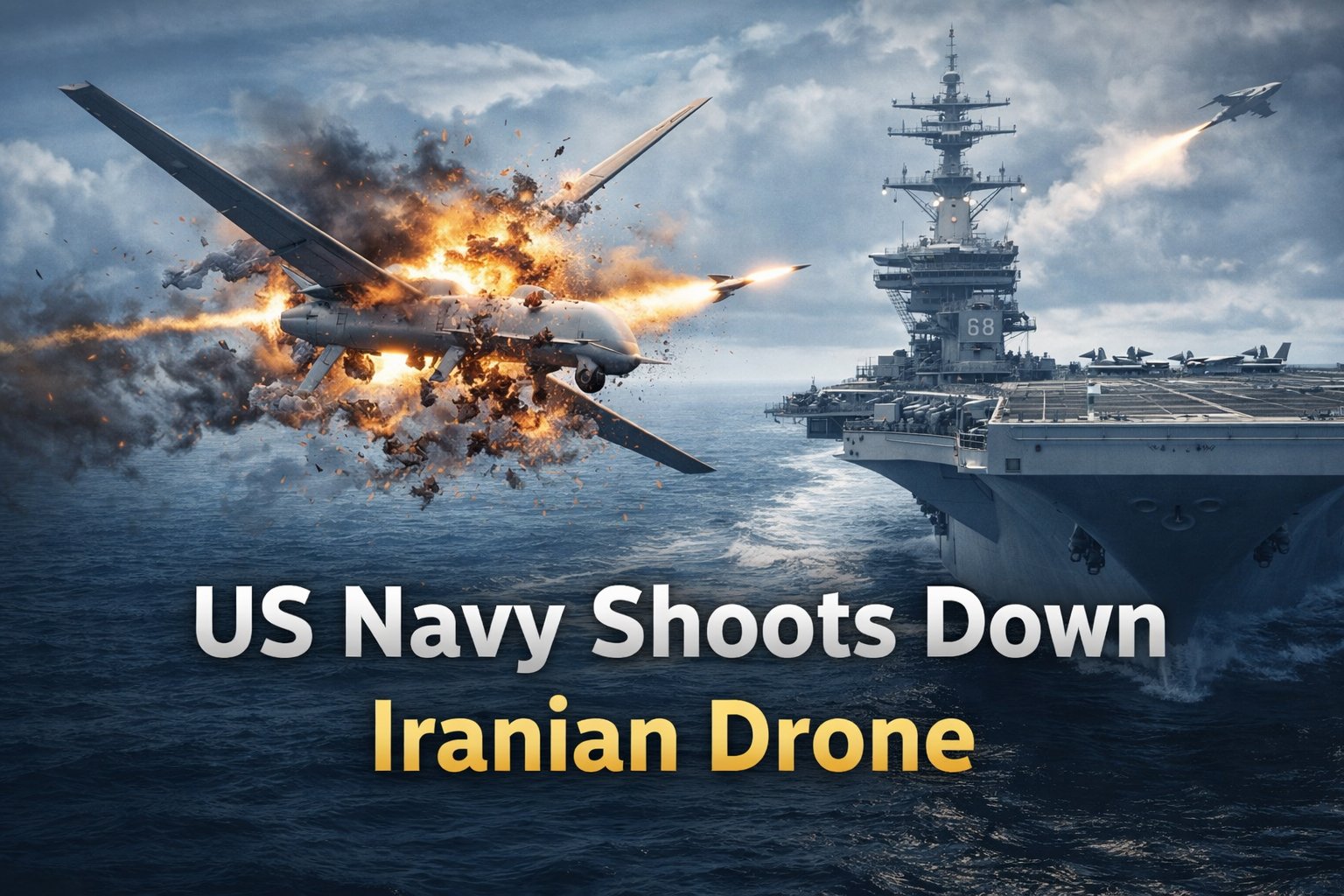
Tensions in the Middle East escalated on Tuesday after United States forces shot down an Iranian drone in the Arabian Sea. The unmanned aircraft was reportedly flying directly toward a U.S. Navy aircraft carrier, prompting defensive action.
According to U.S. Central Command (CENTCOM), the incident involved an Iranian Shahed-139 drone. The military stated that the drone approached the USS Abraham Lincoln in an “aggressive” manner. The aircraft carrier was transiting through international waters in the Arabian Sea, approximately 500 miles off the southern coast of Iran, when the confrontation occurred.
Captain Tim Hawkins, a spokesman for CENTCOM, explained that the drone made “unnecessary maneuvers” toward the American ship. He noted that U.S. forces attempted to de-escalate the situation using standard procedures, but the drone ignored these warnings and continued its path toward the carrier.
Fighter Jet Deployed
Faced with the incoming threat, the U.S. military launched an F-35 fighter jet to intercept the drone. The jet successfully engaged and shot down the Shahed-139.
Captain Hawkins confirmed that no American service members were injured during the incident. The operation was described as a necessary measure to ensure the safety of the ship and its crew.
Second Incident in the Strait of Hormuz
The drone downing was not the only hostility reported on Tuesday. Just hours after the incident with the Abraham Lincoln, CENTCOM reported a second confrontation involving Iranian forces.
This time, forces belonging to Iran’s Islamic Revolutionary Guard Corps (IRGC) targeted a commercial vessel. The ship, identified as the Stena Imperative, is a U.S.-flagged and crewed oil tanker. It was navigating through the Strait of Hormuz, a critical shipping lane for global oil supplies.
Officials said that two Iranian military boats and another drone approached the tanker at “high speeds.” The Iranian forces reportedly threatened to board and seize the commercial vessel.
In response, the U.S. Navy deployed the USS McCaul, a guided-missile destroyer operating nearby. The destroyer arrived on the scene to escort the tanker to safety. It was supported by air cover from the U.S. Air Force to prevent any further aggression.
CENTCOM Response and Regional Tensions
Captain Hawkins emphasized the professionalism of U.S. forces during both encounters. “CENTCOM forces are operating at the highest levels of professionalism and ensuring the safety of U.S. personnel, ships, and aircraft in the Middle East,” he stated.
He issued a stern warning regarding the behavior of Iranian forces. “Continued Iranian harassment and threats in international waters and airspace will not be tolerated,” Hawkins said. He added that such “unnecessary aggression” increases the risk of accidents, miscalculations, and instability in the entire region.
Military Buildup and Political Context
These incidents come amidst a significant buildup of U.S. military power in the region. President Trump recently referred to the deployment as a “massive armada.” Last month, he told reporters that the additional ships were being sent “just in case.”
The administration is closely monitoring the situation in Iran, particularly the government’s response to widespread protests that began late last year. Reports indicate that thousands of demonstrators may have been killed during a severe crackdown by Iranian authorities.
Tensions have remained high as officials weigh their options. Two Defense Department officials previously told CBS News that President Trump was briefed on various military and covert options regarding Iran. However, key U.S. allies in the Middle East have urged the President to exercise caution. They are reportedly encouraging diplomatic talks rather than military strikes.
President Trump’s Stance
Despite the friction, there have been diplomatic channels open. President Trump mentioned to reporters last week that he has engaged in conversations with Iranian officials and intends to continue discussions.
He outlined his two main demands for the Iranian government clearly. “I told them two things: No. 1, no nuclear. And No. 2, stop killing protesters,” Trump said. “They’re going to have to do something.”
Conclusion
The back-to-back incidents on Tuesday highlight the fragile security situation in the Arabian Sea and the Strait of Hormuz. The shooting down of the Shahed-139 drone and the harassment of the Stena Imperative tanker serve as stark reminders of the potential for conflict in these strategic waterways. With U.S. naval forces on high alert and diplomatic efforts continuing in the background, the region remains on edge as both sides navigate this period of heightened tension.