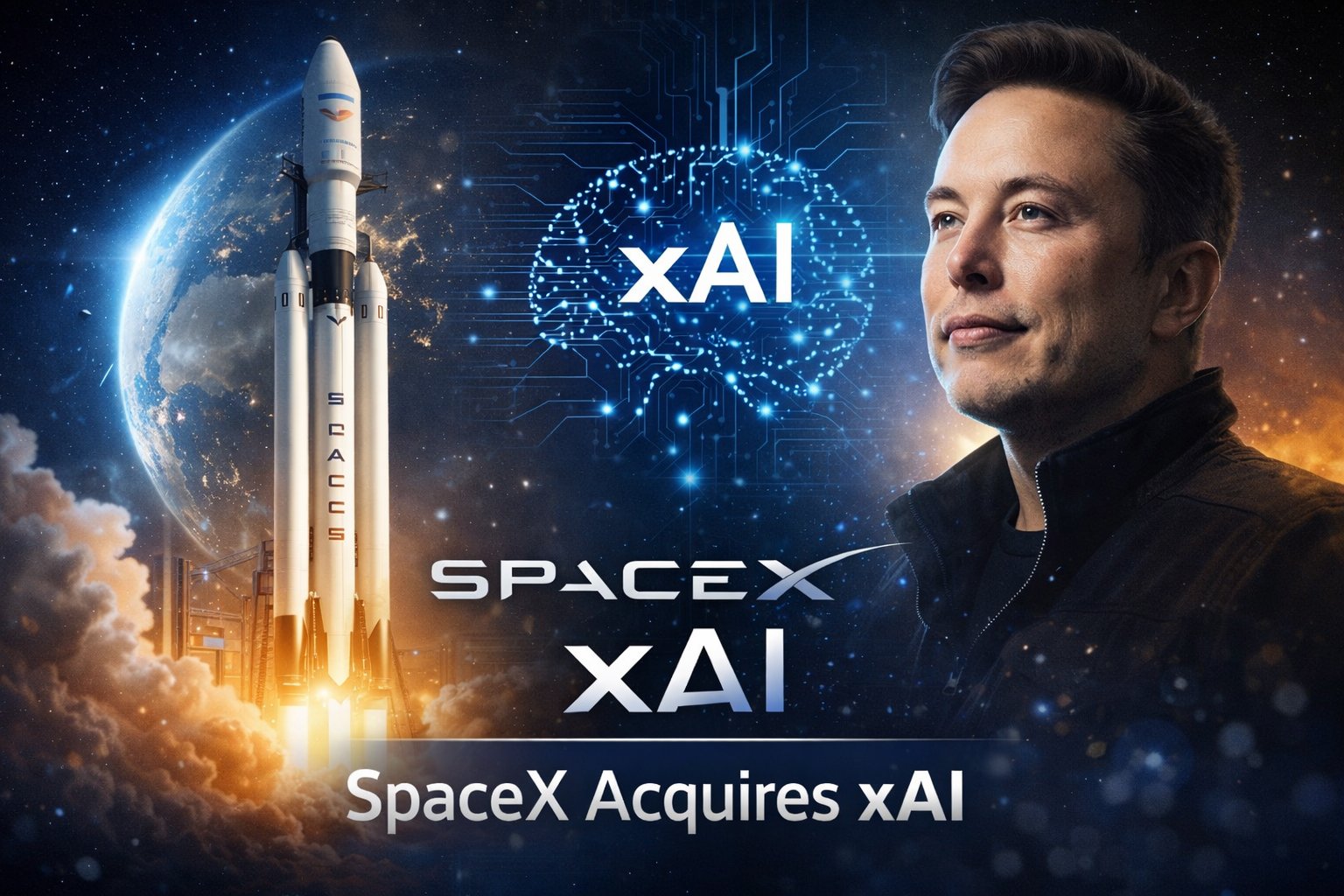
Elon Musk has officially announced a massive new development in his business empire. On Monday, he confirmed that SpaceX has acquired his artificial intelligence startup, xAI. This record-setting deal brings together two of his most ambitious projects: the rocket and satellite giant SpaceX, and the creators of the Grok chatbot, xAI.
The move is designed to unify Musk’s goals for space exploration and advanced artificial intelligence. By combining a major defense contractor with a rapidly growing AI developer, Musk aims to create a powerhouse that can compete with the biggest names in technology.
A Record-Breaking Financial Milestone
The scale of this transaction is historic. According to sources familiar with the details, the deal values SpaceX at a staggering $1 trillion. Meanwhile, xAI is valued at $250 billion.
This acquisition sets a new world record for the largest merger and acquisition (M&A) deal in history. For over 25 years, that title was held by Vodafone’s purchase of Germany’s Mannesmann. That hostile takeover in the year 2000 was valued at $203 billion. The new deal between SpaceX and xAI surpasses that benchmark significantly.
The structure of the deal involves a stock swap. Investors currently holding shares in xAI will receive 0.1433 shares of SpaceX for every single share of xAI they own. Additionally, there is an option for certain xAI executives to choose cash instead of stock. These executives can cash out at a price of $75.46 per share.
Following the merger, the combined company is expected to price its shares at approximately $527 each. This consolidation comes just as SpaceX prepares for a major financial move. The company is planning a blockbuster public offering later this year. This IPO could potentially value the newly merged entity at over $1.5 trillion.
Before this deal, SpaceX was already recognized as the world’s most valuable privately held company, with a valuation of $800 billion from a recent insider share sale. xAI had a valuation of $230 billion as of November.
The Vision: A “Sentient Sun”
Elon Musk has never been shy about his grand ambitions, and this merger is no exception. He described the acquisition as a critical step in a much larger mission.
“This marks not just the next chapter, but the next book in SpaceX and xAI’s mission: scaling to make a sentient sun to understand the Universe and extend the light of consciousness to the stars!” Musk stated regarding the deal.
The strategic logic behind the merger is to share resources. AI development requires massive amounts of energy, data centers, and computer chips. These are costs that drive the budget for xAI. By folding the company into SpaceX, Musk can bolster SpaceX’s own data-center ambitions. This positions the combined company to compete directly with tech giants like Google’s parent company Alphabet, Meta, and the Amazon-backed Anthropic and OpenAI.
Expanding the “Muskonomy”
This deal is the latest step in consolidating Musk’s wide-reaching business interests into a single, tighter ecosystem. Investors and analysts have informally started calling this network of companies the “Muskonomy.”
The ecosystem already includes electric vehicle maker Tesla, brain-chip developer Neuralink, and the tunneling firm, The Boring Company. Musk has a long history of merging his ventures to create mutual benefits.
For example, last year, he folded his social media platform, X, into xAI through a share swap. This move gave the AI startup immediate access to the platform’s vast data and distribution network, which is essential for training AI models like Grok. Going back further to 2016, Musk used Tesla’s stock to acquire SolarCity, his solar energy company.
Potential Hurdles and Scrutiny
While the deal is ambitious, it is likely to attract attention from regulators and investors.
There are potential concerns regarding governance and conflicts of interest. Musk holds leadership roles across multiple firms, and merging them raises questions about how decisions are made. Regulators may look closely at the valuation of the companies and the movement of resources between them. This includes the transfer of engineers, proprietary technology, and lucrative contracts from one entity to another.
The federal government will also be watching closely. SpaceX holds billions of dollars in federal contracts with major agencies, including NASA, the Department of Defense, and various intelligence agencies. These government bodies have the authority to review mergers and acquisitions to ensure they do not pose risks to national security or violate contract terms.
Despite these potential challenges, the deal pushes forward Musk’s plan to create a mutually reinforcing business empire. By merging the physical infrastructure of space travel with the digital intelligence of AI, he is betting on a future where both technologies rely heavily on each other.
Conclusion
Elon Musk’s acquisition of xAI by SpaceX marks a turning point in the tech industry. It creates a trillion-dollar giant capable of challenging the world’s biggest AI developers while continuing to dominate the space sector. While regulatory hurdles may lie ahead, the deal cements Musk’s strategy of unifying his various ventures into one powerful ecosystem. As the company looks toward a massive public offering this year, the combination of rockets and chatbots offers a unique, albeit complex, vision for the future.