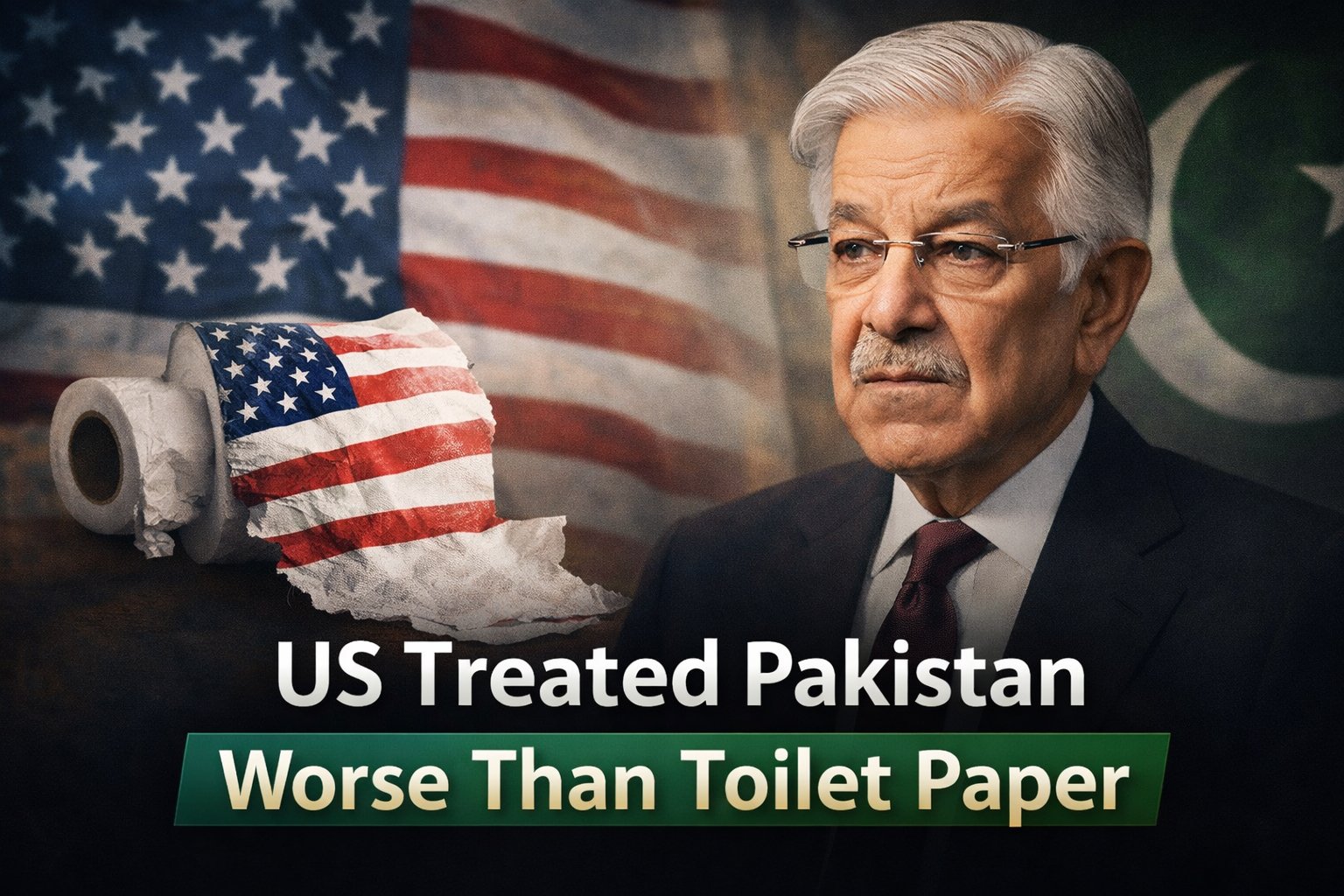
In a blistering address to Parliament, Pakistan’s Defence Minister Khawaja Asif has launched a severe verbal attack on the United States. He accused Washington of exploiting Pakistan for its own strategic military goals before discarding the nation “worse than a toilet paper.”
The Defence Minister’s comments mark a significant admission regarding Pakistan’s foreign policy history. He openly stated that the country’s decision to align itself with the United States, particularly after 1999 and during the war in Afghanistan, was a monumental error. According to Asif, this alliance has inflicted lasting and irreversible damage on Pakistan’s social and economic fabric.
A History of Exploitation
Khawaja Asif did not mince words when describing the nature of the relationship between Islamabad and Washington over the last few decades. He painted a picture of a transactional relationship where Pakistan was used as a tool rather than treated as an ally.
He argued that the United States engaged Pakistan solely to serve American geopolitical interests. Once those interests were met, or when the strategy shifted, Pakistan was left to deal with the fallout alone.
“Pakistan was treated worse than a toilet paper and was used for a purpose and then thrown away,” Asif told the Parliament. This metaphor was used to highlight how disposable the country felt in the eyes of American policymakers after making significant sacrifices.
The Myth of Jihad and the Soviet War
One of the most striking parts of Asif’s speech was his challenge to the historical narrative regarding the Soviet-Afghan war in the 1980s. For decades, the narrative within Pakistan was that the country supported the war against the Soviets out of a religious obligation or “Jihad.”
However, the Defence Minister dismantled this idea. He admitted that the involvement was never about a genuine religious imperative. Instead, he insisted that the war was entirely dictated by American geopolitical interests to counter the Soviet Union.
He stated that the circumstances at the time never actually warranted a declaration of Jihad. Yet, the state mobilized its citizens and sent them to fight across the border. He argued that the people were misled into fighting a war that was not truly their own, but rather a proxy war for a superpower.
Reshaping Minds for War
Asif went deeper into the consequences of this alliance, touching upon the internal changes Pakistan made to support US objectives. He highlighted a disturbing reality about the country’s education system.
To legitimize these wars and mobilize the population, the state reshaped its education curriculum. The Minister noted that specific ideological changes were embedded into the system to encourage a mindset of war and militancy.
He lamented that these changes were not temporary. The ideological shift created to serve American interests in the 1980s and 2000s remains embedded in the system today. The result is a society that continues to grapple with the radicalization that was cultivated decades ago.
The Post-9/11 Blunder
The Defence Minister was particularly critical of the decision to re-align with Washington following the September 11, 2001 attacks. He viewed the post-1999 era as a period of decline for Pakistan’s stability.
By siding with the US during the “War on Terror,” Pakistan invited violence and instability into its own borders. Asif blamed the United States for the wave of radicalization and terror that followed. He argued that the economic strain Pakistan faces today is a direct result of these past decisions.
Irreversible Damage
The speech concluded with a somber assessment of the current situation. Asif expressed that the damage done to the country is not something that can be easily fixed.
He described the consequences of these alliances as “devastating.” The violence, the social division, and the economic hardship are the prices Pakistan is still paying.
“The losses we suffered can never be compensated,” Asif said. He described the country’s past mistakes in foreign policy as “irreversible,” signaling that the scars left by the US-Pakistan partnership will remain for generations to come.
Conclusion
Khawaja Asif’s address to Parliament serves as a harsh reckoning with Pakistan’s past. By admitting that the wars were fought for American interests rather than religious duty, and by using such graphic language to describe the betrayal, the Defence Minister has reopened a debate on the true cost of Pakistan’s relationship with the United States. His message was clear: Pakistan sacrificed its stability for an ally that ultimately treated it as disposable.