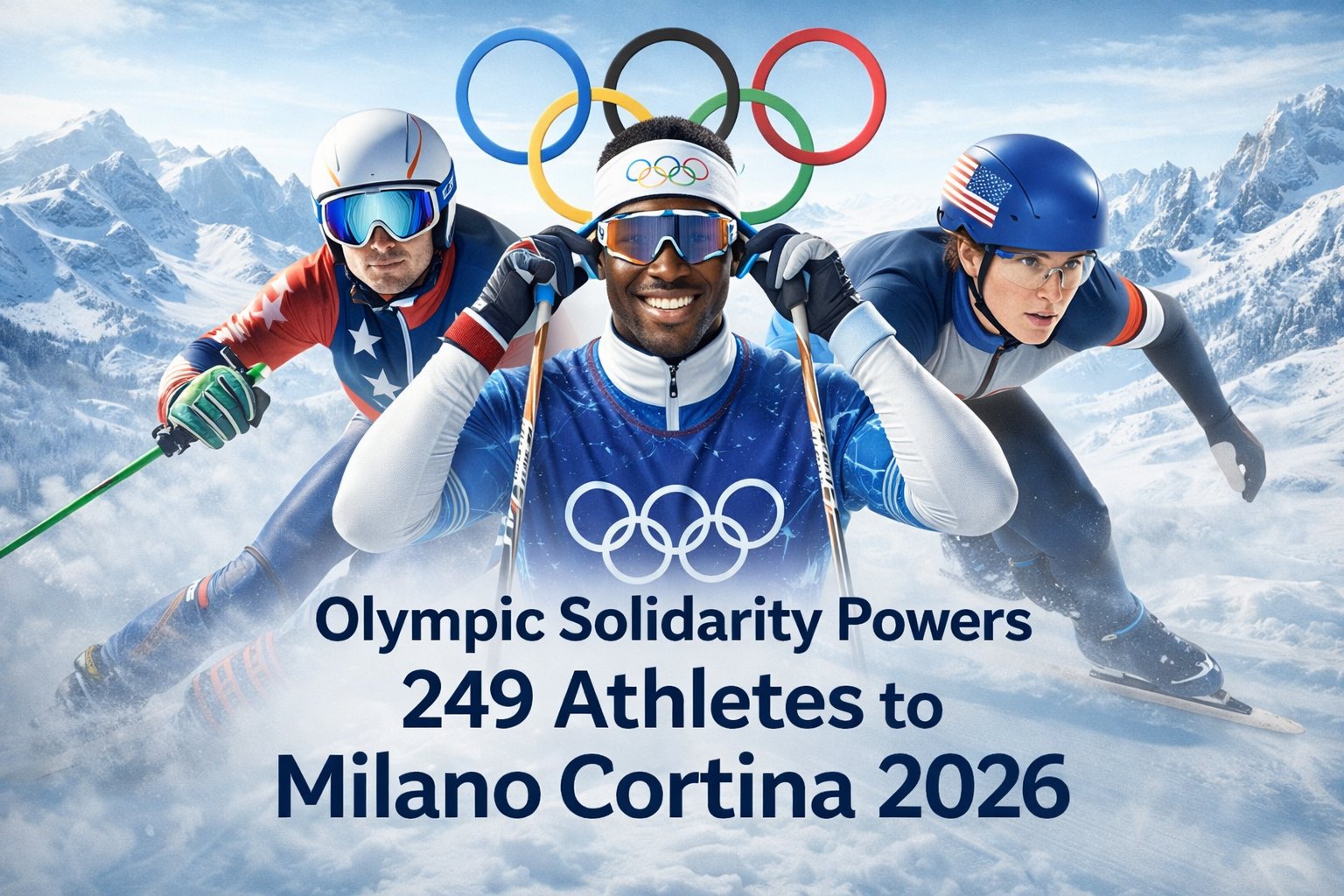
The International Olympic Committee (IOC) has confirmed a major milestone for the upcoming Winter Games. A total of 249 athletes have officially secured their spots for the Milano Cortina 2026 Olympic Winter Games with the direct help of the Olympic Solidarity programme. This initiative is designed to assist athletes from all over the globe, ensuring that financial barriers do not stop talent from reaching the world stage.
This group of qualifiers represents a wide array of nations. The athletes come from 74 different National Olympic Committees (NOCs). They successfully earned their places after receiving individual scholarships. These scholarships provided financial stability and resources throughout the long and difficult qualification period.
A Global Reach
The impact of this support is significant. The 249 qualified athletes make up 56 per cent of all scholarship holders in the programme. This success rate shows that the targeted funding is working effectively.
The group is truly global, spanning five continents. They compete across six different winter sports. This diversity highlights the IOC’s goal to make the Winter Games a truly international event, rather than one dominated only by wealthy nations with natural winter climates.
In total, the programme supported 449 athletes from 90 different NOCs during the build-up to Milano Cortina. While not every scholarship holder qualified, the support gave hundreds of hopefuls the chance to chase their dreams.
Changing Lives and Careers
For many athletes, this funding is the difference between competing and quitting. Winter sports are expensive. They require travel to snowy regions, specialized equipment, and access to ice tracks or ski slopes that simply do not exist in many parts of the world.
Nicole Silveira is a skeleton athlete from Brazil. She is one of the scholarship recipients who has found success. Over the last two seasons, she has achieved three podium finishes in the World Cup. She explains that coming from a tropical country makes winter sports incredibly difficult.
“For me, as an athlete from a tropical country in a winter sport, the Olympic Solidarity scholarship has had a massive impact on my ability to prepare properly for the Games,” Silveira said.
She noted that the money allows her to base herself in Europe and North America. There, she can use the best sleds and work with top coaches. Perhaps most importantly, it buys her time. Without the scholarship, she would have to work extra shifts as a nurse to pay for her season. Now, she can focus entirely on training and recovery.
Professional Preparation
Sára Pónya, a cross-country skier from Hungary, shared a similar experience. She highlighted that the scholarship filled critical gaps in her budget. For the two years leading up to the Olympics, she was able to live like a full-time professional.
“It has enabled me to train more effectively, travel for altitude camps, access recovery therapies and use professional equipment,” Pónya said. She credits these specific improvements with boosting her performance levels significantly.
Leveling the Playing Field
The core mission of Olympic Solidarity is simple. It aims to redistribute the revenue generated by the IOC back into the sport. The focus is on National Olympic Committees that have the greatest need. By doing this, the IOC hopes to level the playing field.
The programme offers monthly financial grants. This money covers daily training costs, whether the athlete is at home or at a specialized center abroad. It can also pay for coaching fees, medical assistance, accommodation, and travel to qualifying competitions.
Samuel Ikpefan, a cross-country skier from Nigeria, emphasized the importance of this access.
“Without this support, it would be very difficult to train and prepare in conditions comparable to the best athletes, especially in Europe,” Ikpefan stated. He believes the programme proves that athletes from countries with fewer resources can still reach the elite level if they are given a fair chance and put in the hard work.
Building on Past Success
The programme has a strong history of delivering results. At the Beijing 2022 Winter Games, Olympic Solidarity helped 236 athletes from 67 nations qualify. Those athletes went on to win 10 medals, including three golds.
One of the biggest success stories from 2022 was Zoi Sadowski-Synnott. The snowboarder won gold in the women’s slopestyle, becoming the first New Zealander ever to win a Winter Olympic gold medal. The programme also supported historic debuts, such as Richardson Viano, the first Haitian winter Olympian, and Aruwin Salehhuddin, the first Malaysian woman to compete at the Winter Games.
Looking to the Future
Support is not limited to individuals. Seven National Olympic Committees with larger teams received tailored assistance to manage their delegations. Additionally, specific grants helped team sports. For Milano Cortina 2026, curling and ice hockey teams from 10 nations received support, and eight of those teams successfully qualified.
The IOC is doubling down on this commitment. For the 2025-2028 period, the budget for Olympic Solidarity has been increased to USD 650 million. This is a 10 per cent increase overall, with a 16 per cent rise specifically for direct athlete support.
Conclusion
As the world looks toward Milano Cortina 2026, the presence of these 249 athletes serves as a reminder of the universality of sport. Through the redistribution of funds, athletes from tropical nations and developing economies will stand on the start line alongside traditional winter powerhouses. The Olympic Solidarity programme continues to ensure that talent and determination, rather than geography or financial background, decide who gets to compete for gold.