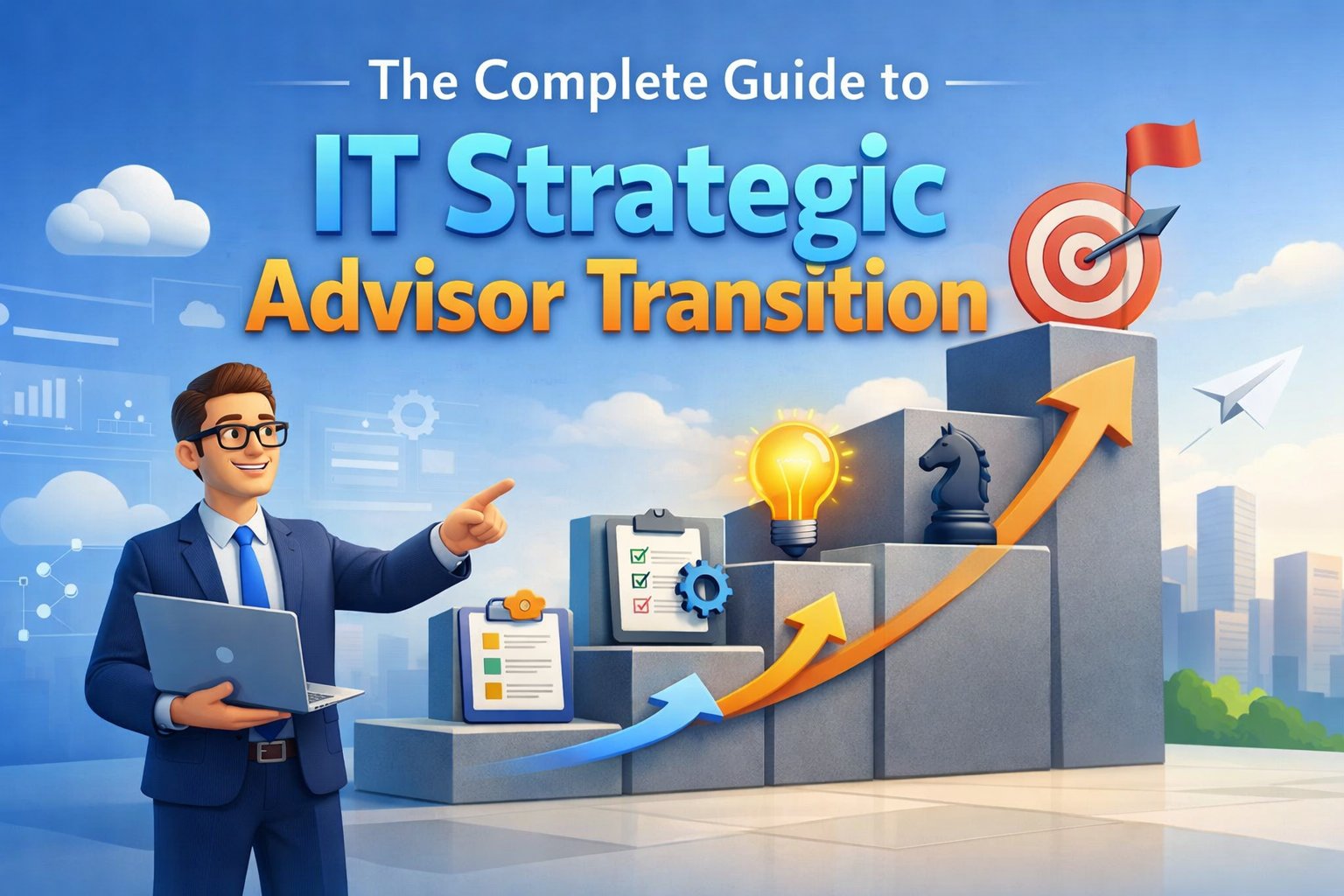
In today’s rapidly evolving business landscape, IT professionals face mounting pressure to move beyond traditional support roles and embrace strategic leadership positions. The transition from “order-taker” to trusted business advisor represents one of the most significant career shifts in the technology sector. This comprehensive guide outlines seven actionable steps that will help you navigate your IT Strategic Advisor Transition successfully.
Breaking Free from the Order-Taking Mentality
The Challenge of Traditional IT Support
Many IT professionals find themselves trapped in reactive support roles, constantly responding to business requests without contributing meaningful strategic value. This limitation stems from a fundamental misunderstanding of IT’s potential role within organizations. Instead of viewing technology as a cost center, forward-thinking companies recognize IT as a strategic enabler of business growth.
The transformation requires shifting from task-oriented thinking to outcome-focused leadership. This evolution forms the foundation of effective Outcome-Based IT Support, where success is measured by business impact rather than ticket resolution rates.
Step 1: Abandon the Passive Approach and Take Initiative
Transform Your Mindset from Reactive to Proactive
Eric Johnson, CIO at PagerDuty, identifies passive mentality as the primary obstacle preventing IT professionals from achieving strategic partnership status. Too many IT teams wait for direction instead of proposing innovative solutions that drive business value.
“Many IT organizations fall into that trap,” Johnson explains. “You’re never going to get to the level that you want within that partnership if you’re not bringing something to the table.”
Bill Young, CTO and operating partner at RightClick, emphasizes this critical mindset shift: IT professionals must transition from thinking “my job is to fix things” to “my job is to improve the business.”
Identify Root Causes, Not Just Symptoms
Dana Stocking, head of IT at AI recruiting startup Mercor, advocates for a deeper investigative approach. When stakeholders request new software or tools, successful IT leaders dig deeper to understand underlying business challenges.
“Don’t just fulfill the request,” Stocking advises. “Dig into the ‘why.’ What underlying issue are they trying to solve? You’ll often discover that an employee’s proposed solution isn’t the best fit.”
This investigative approach enables IT professionals to solve broader organizational challenges that affect multiple teams, demonstrating the strategic thinking essential for successful IT Strategic Advisor Transition.
Step 2: Master Business Operations, Not Just Technical Problems
Immerse Yourself in Business Context
Strategic IT professionals understand business operations as thoroughly as they understand technical systems. This comprehensive knowledge enables them to propose solutions that align with business objectives and deliver measurable value.
Joe Locandro, executive vice president and global CIO at Rimini Street, encourages his team to participate actively in business meetings. “Getting that business vernacular comes through attending business executive meetings and being invited once a month, once a quarter,” he explains.
Build Strategic Business Relationships
Adrienne DeTray, senior vice president and CIO at Universal Technical Institute, emphasizes the importance of strategic proximity to business operations. “Get close to the business, both physically and strategically. Sit in on value stream reviews, understand the strategy and what they’re trying to accomplish.”
For IT professionals supporting specific departments, this means investing time daily with those teams. If you support sales operations, understand the complete sales process, learn about pain points, and familiarize yourself with quarterly targets and success metrics.
Step 3: Lead with Strategic Outcomes, Not Technical Requests
Implement Goal-Oriented Conversations
Rather than accepting requests at face value, strategic IT professionals ask probing questions about business needs and driving factors. This approach shifts conversations toward problem-solving and focuses on outcomes rather than simple solution implementation.
Johnson’s team employs a structured methodology through monthly portfolio alignment meetings where they discuss key initiatives with business partners. “We ask them what the target state is. And if we know the target state, we can actually have conversations with them about proactively what can be done to help them get to that target state.”
Examples of Outcome-Focused Solutions
- Finance teams seeking faster month-end closing: Explore automation opportunities that reduce manual processes
- Sales teams struggling with administrative overhead: Develop tools that eliminate repetitive data entry tasks
- Customer service teams managing high ticket volumes: Implement AI-powered solutions that handle routine inquiries
This strategic approach exemplifies Outcome-Based IT Support, where solutions are designed to achieve specific business results rather than simply addressing surface-level requests.
Step 4: Communicate Business Value, Not Technical Activities
Transition from Activity-Based to Value-Based Reporting
One of the most powerful changes IT professionals can make involves transforming how they communicate about their work. Instead of describing technical activities, focus on business enablement and measurable outcomes.
Locandro observed this challenge repeatedly in his organization: “A lot of the reports that went to [the] business were on activities: how busy everybody was, or ‘we’ve upgraded this,’ or ‘we’ve delivered this.’ No one reported, ‘Here’s the value that was generated as a result of this task.'”
Frame Impact in Business Terms
Noe Ramos, vice president of AI operations at Agiloft, provides an excellent example: “Instead of saying, ‘We automated this process,’ say, ‘We freed up 200 hours a month for the sales team to focus on revenue-generating work.’ That shift from inputs to outcomes reframes IT’s role as an enabler of strategy tied to business objectives.”
Christopher Daden, CTO at Criteria Corp, reinforces this approach: “IT professionals should frame every initiative in terms of the business problem it solves, the risk it reduces, or the opportunity it unlocks.”
Step 5: Build Momentum Through Strategic Quick Wins
Focus on Cumulative Small Improvements
Strategic IT leaders understand that transformation doesn’t always require massive projects. Sometimes the most effective approach involves identifying quick wins that deliver immediate value and build credibility for larger initiatives.
Johnson advocates for this incremental approach: “Small things can add up to a big thing. If you see things that are smaller, quick wins that can be a benefit to the organization that they’re partnering with, sometimes it’s a process that could be automated.”
Optimize Technology Investments
Meg Donovan, chief people officer at Nexthink, describes how her IT team provides data showing software utilization patterns. “We think we need this tool. Well, do we really need this tool? And do we need 2,500 licenses? Because it can show me that they’re only using 10.”
This data-driven approach to technology optimization demonstrates strategic thinking and delivers immediate cost savings while improving operational efficiency.
Step 6: Measure and Validate Strategic Impact
Implement Comprehensive Impact Assessment
Strategic IT professionals don’t consider projects complete upon deployment. They measure the difference between pre-implementation and post-implementation states to determine actual business impact.
Johnson emphasizes this critical follow-through: “I find many companies don’t do as much of that as they should. They’re really quick to find the problem and put the solution in play, but not take that final step, which is probably the most important: Did it make the impact you expected it to?”
Continuous Improvement Methodology
When results fall short of expectations, strategic IT leaders investigate root causes and implement corrections. This might involve refining existing solutions or developing entirely new approaches. This iterative methodology ensures that Outcome-Based IT Support delivers consistent business value.
Step 7: Leverage AI to Amplify Strategic Capacity
Automate Routine Tasks to Focus on Strategy
Artificial intelligence serves as a powerful enabler for IT professionals pursuing strategic roles. By automating repetitive tasks, AI frees up capacity for higher-value strategic initiatives.
Many organizations deploy AI-based solutions for level-one support, allowing IT professionals to focus on projects with greater business impact than routine ticket resolution.
Real-World AI Implementation Success
Daden’s team achieved remarkable results through strategic AI implementation: “More than 80% of our production code is now authored by AI systems, which has increased engineering productivity by at least 30%. By redesigning workflows and integrating intelligent automation, the team achieved more than 94% ticket deflection while maintaining and even improving candidate satisfaction.”
AI Tools for Strategic Enhancement
Young highlights the strategic value of AI note-taking tools that eliminate meeting documentation distractions. These tools enable IT professionals to focus entirely on conversation flow and decision-making processes rather than administrative tasks.
“There is nothing worse than being in a flow and having to break that to take notes,” Young explains. “These AI note-taking tools enable meetings to flow at a normal pace and can give the team a summary of action items and talking points.”
The Future of IT Strategic Leadership
Embracing the Evolution
The successful IT Strategic Advisor Transition requires more than technical expertise. It demands business acumen, strategic thinking, communication skills, and a commitment to continuous learning. IT professionals who embrace this evolution position themselves as indispensable business partners rather than cost centers.
Building Sustainable Strategic Impact
Organizations that implement Outcome-Based IT Support models create sustainable competitive advantages through technology-enabled business transformation. This approach aligns IT investments with business objectives and ensures that technology initiatives deliver measurable value.
Conclusion: Your Path to Strategic IT Leadership
The transition from traditional IT support to strategic advisory roles represents both a significant challenge and an enormous opportunity. By implementing these seven proven steps, IT professionals can transform their careers and deliver unprecedented value to their organizations.
Success requires patience, persistence, and a willingness to step outside traditional comfort zones. However, the rewards—both professional and organizational—justify the investment. Strategic IT leaders shape business futures, drive innovation, and create lasting impact that extends far beyond traditional technical boundaries.
The future belongs to IT professionals who understand that their role extends far beyond maintaining systems and resolving tickets. It belongs to those who embrace strategic thinking, focus on business outcomes, and position technology as a catalyst for organizational success.