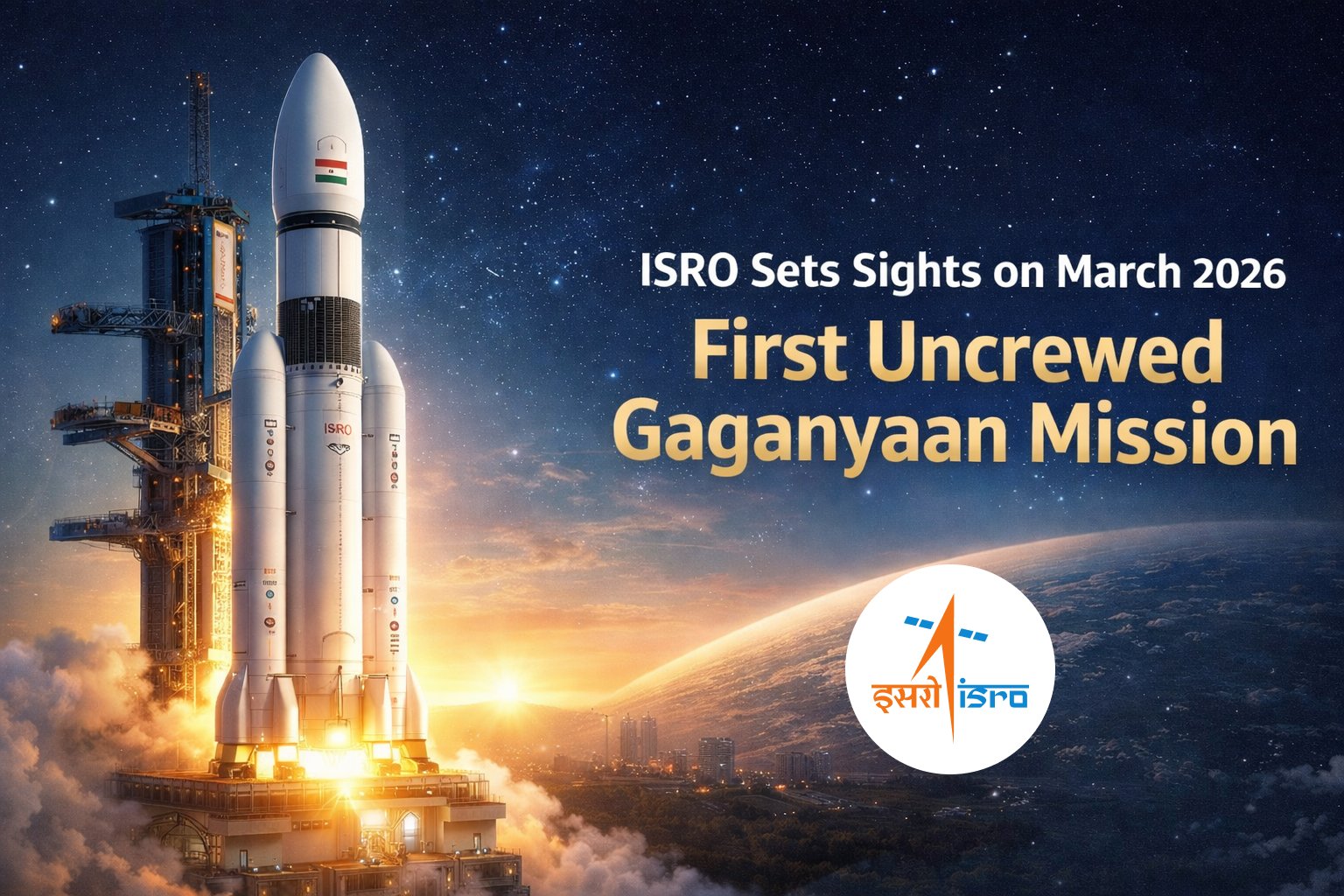
The Indian Space Research Organisation (ISRO) is entering the final stages of preparation for a historic event in the nation’s space journey. The space agency is currently working against the clock to finalize all systems for the first uncrewed mission of the Gaganyaan programme. Officials have set a specific target launch window for this critical flight: March 2026.
This upcoming mission, designated as G1, is not just a routine test flight. It serves as the foundation for India’s ultimate goal of sending humans into space. The G1 mission is reported to be 90 percent complete. Its success is vital for India’s aspiration to become only the fourth country in the world to launch humans into space independently, following Russia, the United States, and China.
Assembly and Integration Milestones
The path to the March 2026 launch has been paved with steady progress over the last few years. ISRO began the complex assembly of the launch vehicle well in advance. On December 18, 2024, engineers commenced the assembly of the Human-Rated Launch Vehicle Mark-3. This work is taking place at the country’s primary spaceport, the Satish Dhawan Space Centre in Sriharikota.
Since that start date, the technical teams have hit several major integration targets. In January, the crew module propulsion system was successfully integrated into the vehicle. This system is crucial for maneuvering the spacecraft once it reaches orbit. Following this, another essential safety component was readied. In May 2025, a set of ten parachutes was shipped out for final preparations. These parachutes are the lifeline of the mission, designed to ensure a safe and controlled re-entry into Earth’s atmosphere and a soft landing.
Meet Vyommitra: The Test Pilot
While the G1 mission is officially “uncrewed,” the spacecraft will not be empty. It will carry a special passenger named Vyommitra. This is a half-humanoid robot developed specifically for this programme. Vyommitra plays a central role in ensuring the safety of future human astronauts.
The robot is designed to simulate the exact conditions that a human crew would face inside the capsule. Throughout the flight, Vyommitra will monitor life-support systems and provide critical data to ground stations. This information will tell scientists if the environment inside the crew module is safe and stable for human beings.
Thousands of Safety Tests
Safety is the highest priority for the Gaganyaan programme. ISRO Chairman V Narayanan has highlighted the sheer volume of testing that has gone into this project. According to the Chairman, the agency has conducted more than 8,000 ground tests to date. These tests cover every aspect of the mission, including structural qualifications to ensure the rocket can withstand the immense pressures of launch.
The results have been highly encouraging. The Chairman noted that these tests have achieved a 97 percent success rate. This high level of reliability is necessary to validate the performance of the human-rated launch vehicle before any person is allowed on board.
The Mission Profile
The G1 mission has a specific flight path designed to test all critical technologies. The launch vehicle will lift off and insert the spacecraft into an orbit of 170×408 km around the Earth. Once in orbit, the mission will validate the operations of the orbital module.
After completing its time in space, the spacecraft will begin its return journey. This phase is designed to test the re-entry technologies and the crew module recovery systems. The mission will conclude with a splashdown in the waters of the Bay of Bengal, where recovery teams will retrieve the module.
The Road to Human Spaceflight
The G1 mission is just the beginning of a busy schedule for ISRO. Following this flight, the agency has planned two more uncrewed missions, named G2 and G3. These are scheduled to take place throughout the remainder of 2026. These subsequent flights will further verify the systems and fix any issues identified during the G1 mission.
If all three uncrewed flights are successful, the programme will move to its main event. The first crewed spaceflight mission, H1, is currently scheduled for 2027. During this historic mission, three Indian astronauts will travel to low Earth orbit. They are expected to stay in space for up to seven days before returning home.
A Vision for the Future
The Gaganyaan programme is a massive undertaking with a total budget of Rs 20,193 crore. It is not just about a single flight but includes a total of eight missions. These missions are stepping stones toward a much larger long-term goal. ISRO aims to use the experience gained from Gaganyaan to establish the Bharatiya Antariksha Station—India’s own space station—by the year 2035.
Conclusion
With the March 2026 launch window fast approaching, ISRO is focused on clearing the final hurdles for the G1 mission. The successful integration of propulsion systems, the readiness of recovery parachutes, and the deployment of the Vyommitra robot all point toward a comprehensive validation of India’s human spaceflight capabilities. As the agency completes its 8,000th test, the dream of seeing Indian astronauts launch from Indian soil draws closer to reality.