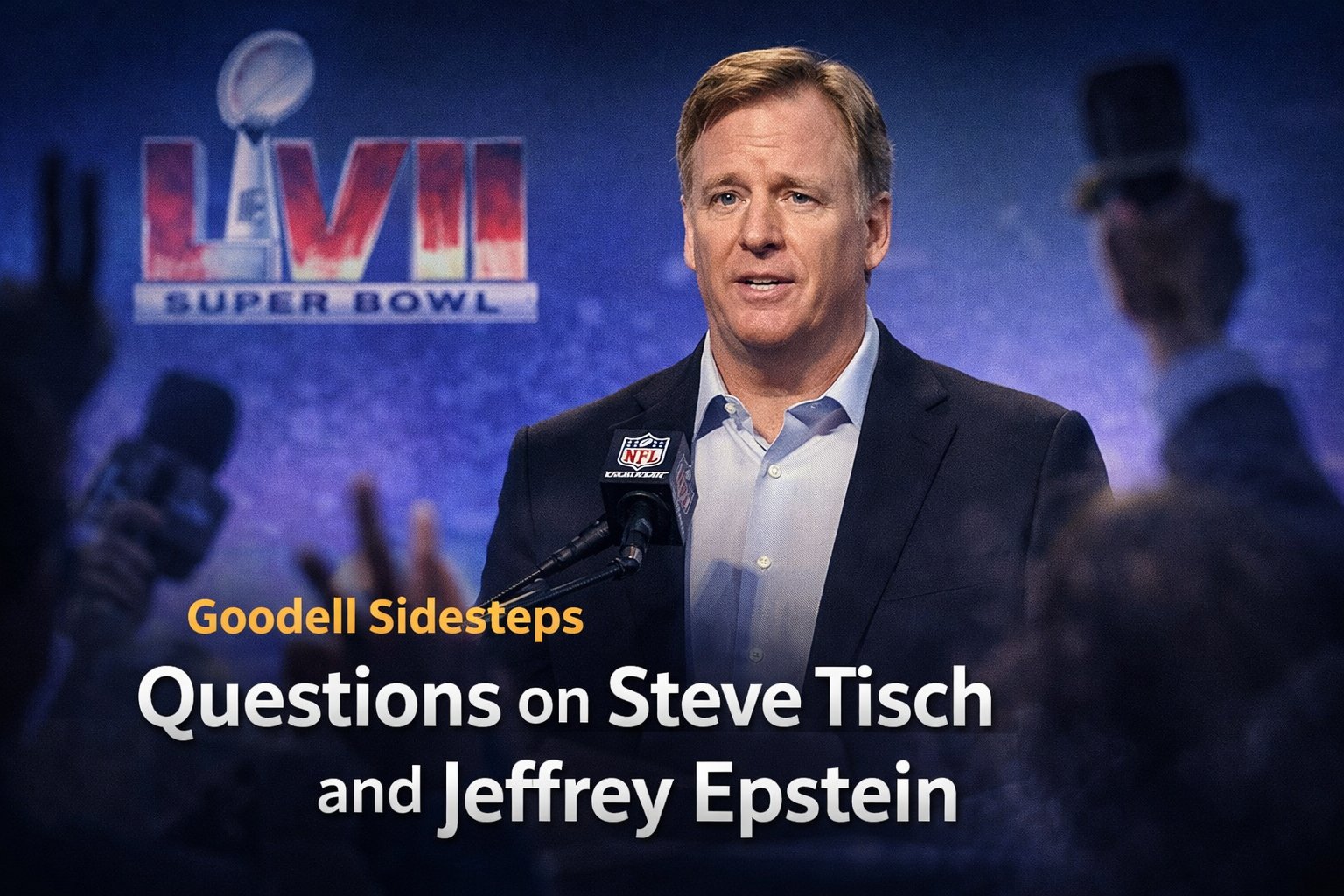
During his annual Super Bowl news conference on Monday, NFL Commissioner Roger Goodell faced difficult questions regarding New York Giants co-owner Steve Tisch. Specifically, reporters asked about Tisch’s relationship with the late, disgraced financier and convicted sex offender Jeffrey Epstein.
Goodell’s response was cautious. He avoided giving a direct answer about potential discipline. instead, the Commissioner stated that the league needs to “get the facts first” before making any decisions. This approach has drawn criticism from observers who feel the NFL is moving too slowly on a serious moral issue.
The Connection to Epstein
The controversy stems from the release of extensive documents, audio files, and videos related to Jeffrey Epstein. According to reports, Steve Tisch’s name appears in these documents more than 400 times.
The timing of these interactions is a major point of concern. The correspondence between the two men primarily took place years after Epstein had already pleaded guilty to procuring a child for prostitution. This means the association continued well after Epstein was a known and convicted offender.
Despite this, the NFL’s official stance remains vague. Goodell’s comments at the press conference were seen by many as a way to deflect the issue rather than address it head-on. By claiming they need to look at all the facts, the league buys itself time. However, critics argue that waiting for a full factual accounting from law enforcement is a stalling tactic. With a global network of authorities struggling to sort through the massive volume of names connected to Epstein, the NFL may never get a “complete” picture from the police alone.
A History of Discipline
The hesitation to act stands in stark contrast to how the NFL has handled other owners in recent years. When the league wants to take a moral stand, it has shown it has the power to do so swiftly and severely.
For example, Dan Snyder, the former owner of the Washington Commanders, faced massive fines and was eventually pushed out of the league entirely. This was due to a toxic workplace culture that the NFL deemed unacceptable. Similarly, Jerry Richardson, the former owner of the Carolina Panthers, was removed from his position quickly following allegations of workplace sexual misconduct.
In those cases, the NFL did not wait for years of criminal proceedings to conclude before taking action to protect its brand. The league decided that the conduct was detrimental to the sport and acted accordingly. Yet, in the case of Tisch, the leadership seems content to wait.
Double Standards for Players vs. Owners
The situation also highlights a perceived double standard between how the league treats its players versus its owners. The Roger Goodell era has been defined by strict discipline for players who damage the shield’s reputation.
Fans remember the case of quarterback Michael Vick. The NFL suspended him indefinitely for his role in a dogfighting ring. The suspension was not just about the legal outcome; it was about the public outrage and the moral failure of his actions. Similarly, Plaxico Burress was held accountable by the league after he accidentally shot himself in a nightclub.
In these instances, the NFL used public perception as a tailwind to enforce discipline. The message was clear: if you embarrass the league or engage in criminal behavior, you will be punished. Critics argue that owners should be held to the same standard. If associating with a convicted sex offender damages the public trust, then the league should act with the same force it uses against players.
The “Bellwether” Moment
This situation is about more than just one team owner. It serves as a test case for how high-profile figures will be treated moving forward. Tisch is not the only powerful person named in the Epstein files. Politicians, businessmen, and celebrities have all been linked to the network.
How the NFL handles this situation could set a precedent. Tisch has maintained his innocence. He has stated that the women he discussed with Epstein were of appropriate age. However, the core issue for many is the association itself. At the time of their correspondence, Epstein was already a convict.
Observers argue that there should be a non-political, moral agreement in society. The argument is that voluntarily associating with a predator like Epstein should be grounds for removal from high-ranking leadership positions. It suggests that anyone floating in that circle should face consequences, regardless of their wealth or political influence.
Goodell’s Concern vs. Action
At the press conference, Goodell did admit he was “concerned” about an NFL owner being tied to Epstein. He acknowledged that it reflects poorly on the brand. However, when a reporter pressed him on the possibility of punishment, Goodell suggested the reporter was getting ahead of herself.
This reaction has shaken confidence in the Commissioner’s willingness to apply common sense to the situation. It feels similar to the league’s past struggles, such as the scandal involving Patriots owner Robert Kraft. In that instance, the league found it difficult to police an owner with the same harshness it applies to athletes.
Conclusion
The world is watching. Industries outside of football—including Hollywood, the music business, and politics—are looking to see what the NFL will do. They are waiting to see if the league will stop treating owners with kid gloves.
While Goodell’s comments on Monday did not promise any immediate action, the silence speaks volumes. Owners are very good at closing ranks and protecting their own when necessary. This is not a criminal court, and the standard of proof does not need to be “beyond a reasonable doubt” for the league to act. For the powerful figures involved, facing consequences from their peers might be the only form of justice they ever encounter. Whether the NFL chooses to deliver that justice remains to be seen.