A major debate is heating up in the technology world. On one side, there is the urgent need to protect the planet and reduce emissions. On the other side, there is the explosive growth of artificial intelligence. AI requires a massive amount of electricity to run, and this hunger for power is making it hard for big companies to stay green.
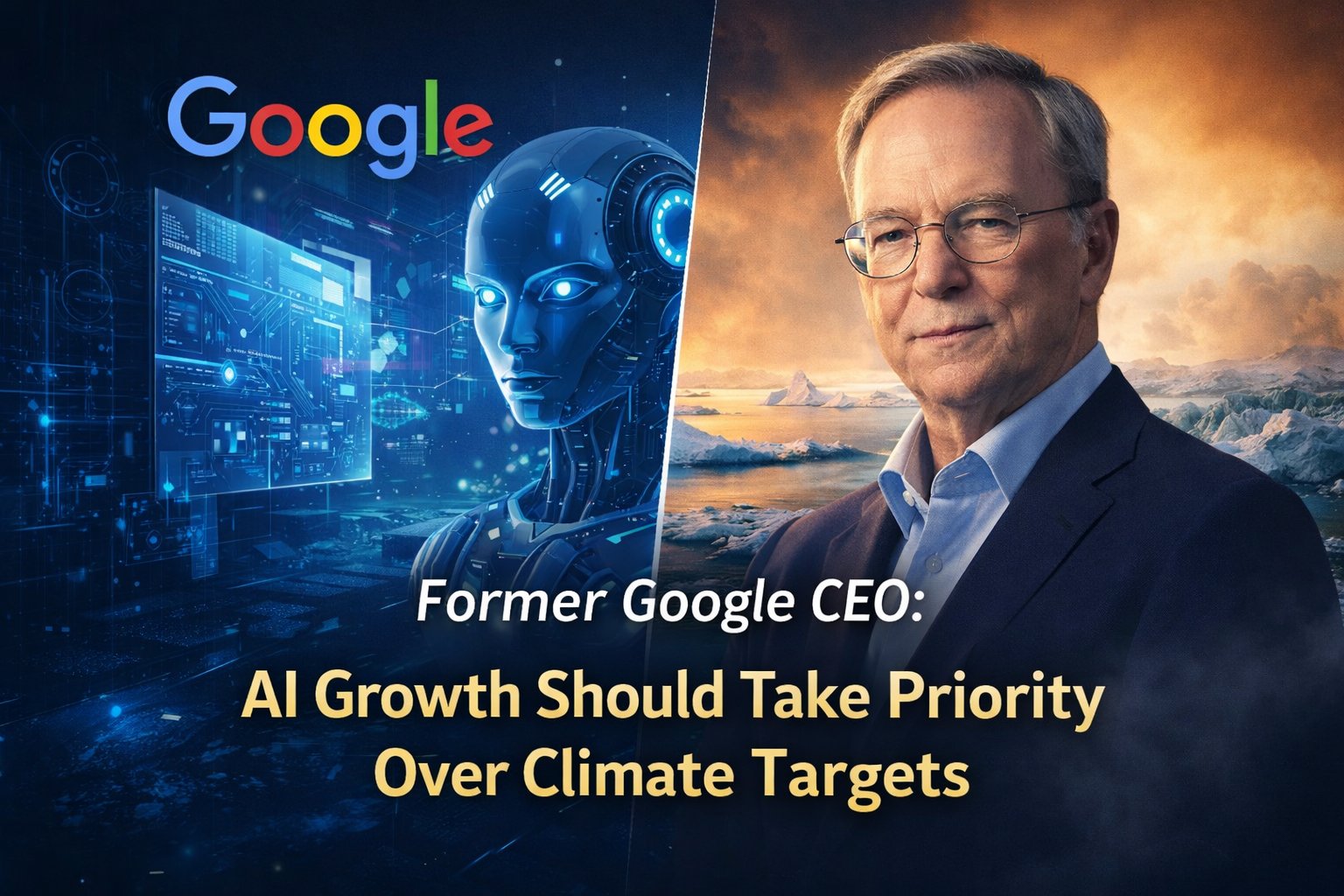
Now, a prominent voice in the industry has taken a controversial stance. Eric Schmidt, the former CEO of Google, believes that the world should stop worrying so much about meeting immediate climate goals if it means slowing down AI. His argument is simple but stark: we are likely going to miss those climate targets anyway.
Schmidt’s Bold Argument
Eric Schmidt recently spoke at an AI summit in Washington. During his appearance, he suggested that trying to restrict the energy use of artificial intelligence is the wrong approach. He argued that the current systems in place to control climate change are not working effectively.
“We’re not going to hit the climate goals anyway, because we’re not organized to do it,” Schmidt stated.
Instead of cutting back on AI development to save energy, Schmidt proposed a different path. He believes we should let AI grow without restrictions. His hope is that an advanced, powerful AI will eventually be smart enough to solve the climate problem for us.
“I’d rather bet on AI solving the problem, than constraining it and having the problem,” he explained.
Schmidt is not just a commentator; he is an active investor in the field. He has put money into various AI projects. This includes a defense company called White Stork. This company is currently testing a new fleet of military drones powered by artificial intelligence. For Schmidt, the potential of this technology outweighs the immediate environmental costs.
The Reality of Google’s Emissions
Schmidt led Google for a decade, from 2001 to 2011. During his time as CEO, the company reached “carbon neutral” status for the first time. Since then, Google has worked hard to present itself as a climate-conscious brand. They have made plans to invest in clean energy and eliminate their carbon legacy.
However, the reality of the AI boom is making these goals difficult to reach. Google has publicly admitted that its target to reach net-zero emissions by the year 2030 is slipping away.
The company released a sustainability report in 2024 that highlighted this struggle. The data showed that Google’s total greenhouse gas emissions jumped by 48 percent between 2019 and 2023. The report linked the majority of this increase to the higher processing demands that began in 2022. As AI becomes more complex, the data centers that power it require much more electricity, leading to higher emissions.
Hidden Emissions in Big Tech
The problem might be even bigger than the official reports suggest. A recent report from The Guardian uncovered that the emission statistics coming from Big Tech companies might be misleading.
The industry often uses what they call “market-based” figures. This allows companies to use creative accounting methods, such as buying renewable energy certificates, to make their carbon footprint look smaller than it actually is. When looking at the real, unadjusted numbers, the environmental impact is much severe.
Among the major tech giants, Amazon was identified as a significant offender in this adjusted report. The data suggested Amazon had more than double the emissions of its closest competitor on the list.
Both Google and Microsoft are also grappling with rising emissions since 2020. However, these two companies stood out for a different reason. They have pledged to move away from these opaque reporting systems. They intend to phase out the confusing “market-based” accounting to provide a clearer picture of their real environmental impact.
The Scramble for Power
The tech industry is now in a race to find enough power to keep their AI systems running. Different leaders are choosing different paths.
Some executives, like Sam Altman of OpenAI, are trying to push for sustainable energy options to power their technology. They want to find a way to balance growth with green energy.
However, the demand is so high that some companies are doubling back to fossil fuels to keep the lights on. The current energy grid simply cannot keep up with the speed of AI investment.
This has led to a renewed interest in nuclear energy. Several of the biggest names in tech, including Microsoft, are exploring nuclear power. They believe that nuclear energy might be the only source capable of providing the consistent, massive levels of electricity needed to support the future of AI without destroying the atmosphere.
Conclusion
The conversation around AI is no longer just about chatbots or smart software. It is now a critical conversation about the world’s energy resources. Eric Schmidt’s comments highlight a growing sentiment among some tech leaders: the belief that the benefits of AI are worth the environmental price tag.
While Google and Microsoft try to fix their accounting and find new power sources, the numbers show a clear trend. Emissions are rising, and the targets set years ago are being left behind. Whether AI will eventually save the planet, as Schmidt hopes, or simply consume more of its resources, remains the biggest gamble of the coming decade.