Tony Waterfall’s life as a mariner on Canada’s west coast provided the inspiration for a new way of looking at the cosmos. By day, he navigated the intricate waterways and islands of the Salish Sea in British Columbia, working on sailing yachts and motorized cruisers. By night, anchored in deep, quiet bays, he spent his hours observing the vast night sky. These experiences instilled in him a deep sense of the interconnectedness of nature—the tides, the winds, and the celestial bodies above.
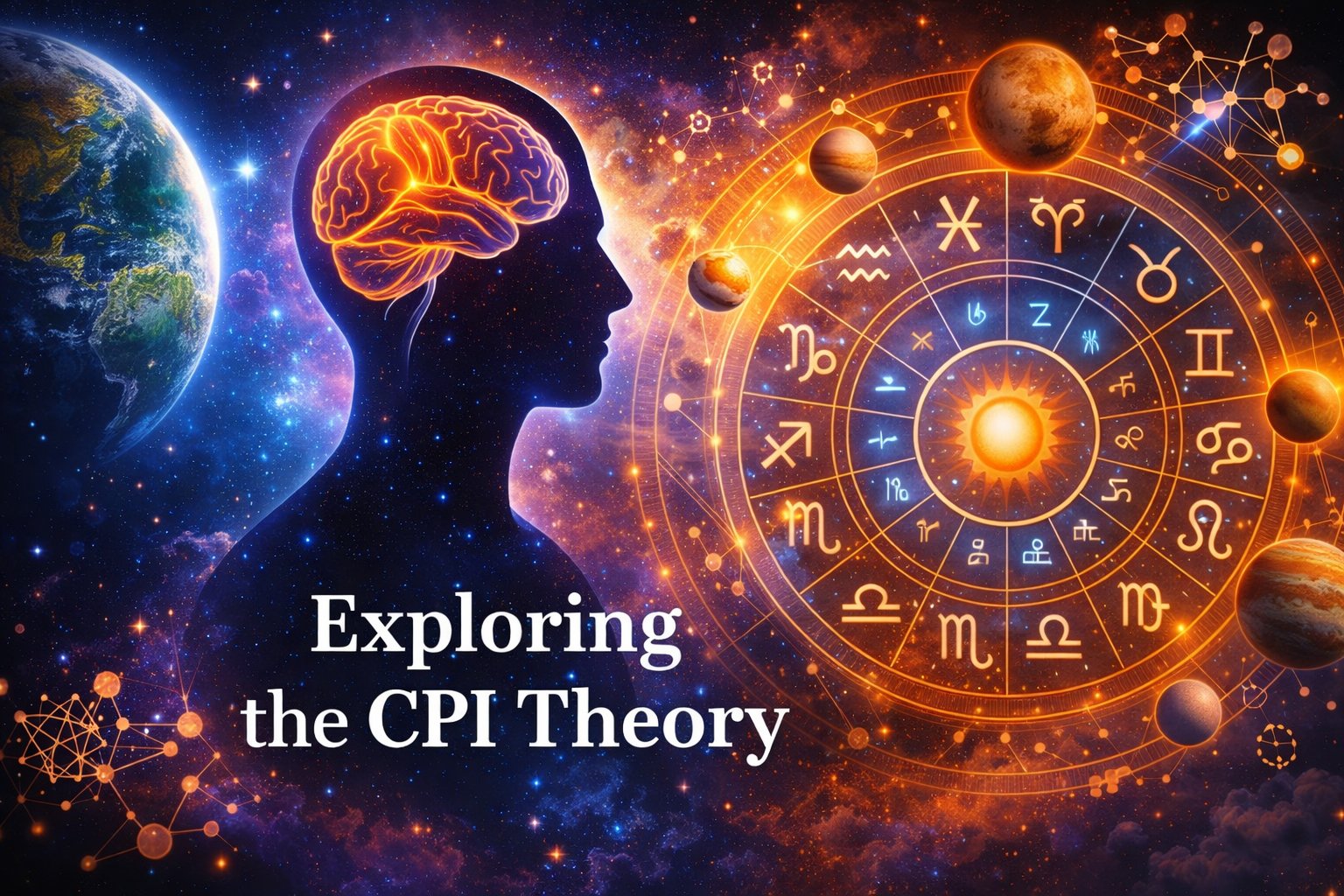
Combining his practical knowledge of natural laws with an interest in astrophysics and astrology, Waterfall developed the Continuous Planetary Interaction Theory, or CPI Theory. While Waterfall clarifies that this is currently a plausible working hypothesis rather than a strictly proven scientific theory, its significance lies in providing a potential physical mechanism for astrological claims.
The Connection Between the Sun and Earth
To understand CPI Theory, one must first look at the relationship between the Earth and the Sun. The Sun is essentially a massive, hot ball of plasma made mostly of hydrogen particles. This plasma is so energetic that particles can escape the Sun’s gravity and blast into space. This stream of particles is known as the Solar Wind.
The Solar Wind travels across the solar system, interacting with the magnetic fields and atmospheres of the planets. On Earth, our magnetic field—the Magnetosphere—acts as a shield. When the Solar Wind hits this shield, it causes electrical currents to flow between the Magnetosphere and the Ionosphere, which is the upper part of our atmosphere.
This interaction is what creates the famous auroras. When charged particles from the Sun get trapped and collide with air molecules in our atmosphere, they light up the sky in dancing streams of color. In the north, this is the Aurora Borealis, and in the south, it is the Aurora Australis. From a satellite’s perspective, these appear as glowing rings around the poles, known as auroral ovals.
Portals for Planetary Energy
Recent astronomical discoveries have shown that Earth is not alone in this. Auroral ovals have been found on Mercury, Mars, Jupiter, Saturn, Uranus, Neptune, and even Pluto. Venus is the only major exception, likely due to its very weak magnetic field.
According to CPI Theory, these auroral ovals do more than just receive energy; they act as “portals.” Waterfall suggests that energy is constantly being exchanged through these rings. Energy leaves one planet and travels across interplanetary space to enter the ionosphere of another. This creates a continuous loop of energy moving between the planets of our solar system.
Interaction at the Subatomic Level
Waterfall’s theory goes deeper, looking at the behavior of protons and electrons. He views the solar plasma as a wave-field of electrons that carry protons from the Sun to the Earth. Once these electrons reach the ionosphere, they release their “proton cargo.”
These free electrons then interact with other elementary particles that have arrived in the ionosphere from elsewhere in space. Waterfall believes that every one of these interactions is recorded as an “astrological moment” with specific potentials.
The most important part of this hypothesis for humans is how it affects us. Every planet in the solar system, including the Moon, has an ionosphere where these particles are constantly joining and separating. This creates a shifting electromagnetic field. Since the human body contains trillions of electrons, Waterfall argues that we are naturally responsive to these constant changes in the atmospheric field. In short, the proposed mechanism for how planets influence humans is electromagnetism.
A Shift in Scientific Focus
Waterfall advocates for a change in how we study physics. He believes that science has focused too much on the nucleus of the atom—splitting and smashing it to understand power. He suggests that we should instead focus on the electron.
“The electron is the game changer,” Waterfall says. He believes that by elevating our understanding of the electron, we might find a force that unifies everything. He points out that light is the visualization of the electron, and as “creations of light,” humans are deeply connected to this illuminated force.
The Future of the Theory
The CPI Theory has already been reviewed by several leading research astrologers. After analyzing the concept, their response was positive. They view it as a plausible explanation for how astrology might actually work on a physical level. The next step for the theory is the development of experimental designs to test these ideas.
Waterfall follows in the footsteps of researchers like Dr. Percy Seymour, using modern science to solve a very old puzzle. The theory suggests an elegant pattern where life on Earth is shaped not just by the Sun, but by a complex, continuous interaction with all the planets.
For those interested in the full details, Waterfall has published a 300-page book titled CPI Theory: Continuous Planetary Interaction Theory. The book includes extensive references to scientific journals and papers to support its claims.
Conclusion
The CPI Theory represents a bold attempt to bridge the gap between ancient astrological beliefs and modern astrophysics. By identifying the ionosphere and auroral ovals as gateways for electromagnetic exchange, Tony Waterfall offers a framework where planetary movements have a tangible, physical effect on the Earth’s environment and the humans living within it. Whether this hypothesis stands up to rigorous experimental testing remains to be seen, but it provides a sophisticated new perspective on our place in the solar system.