
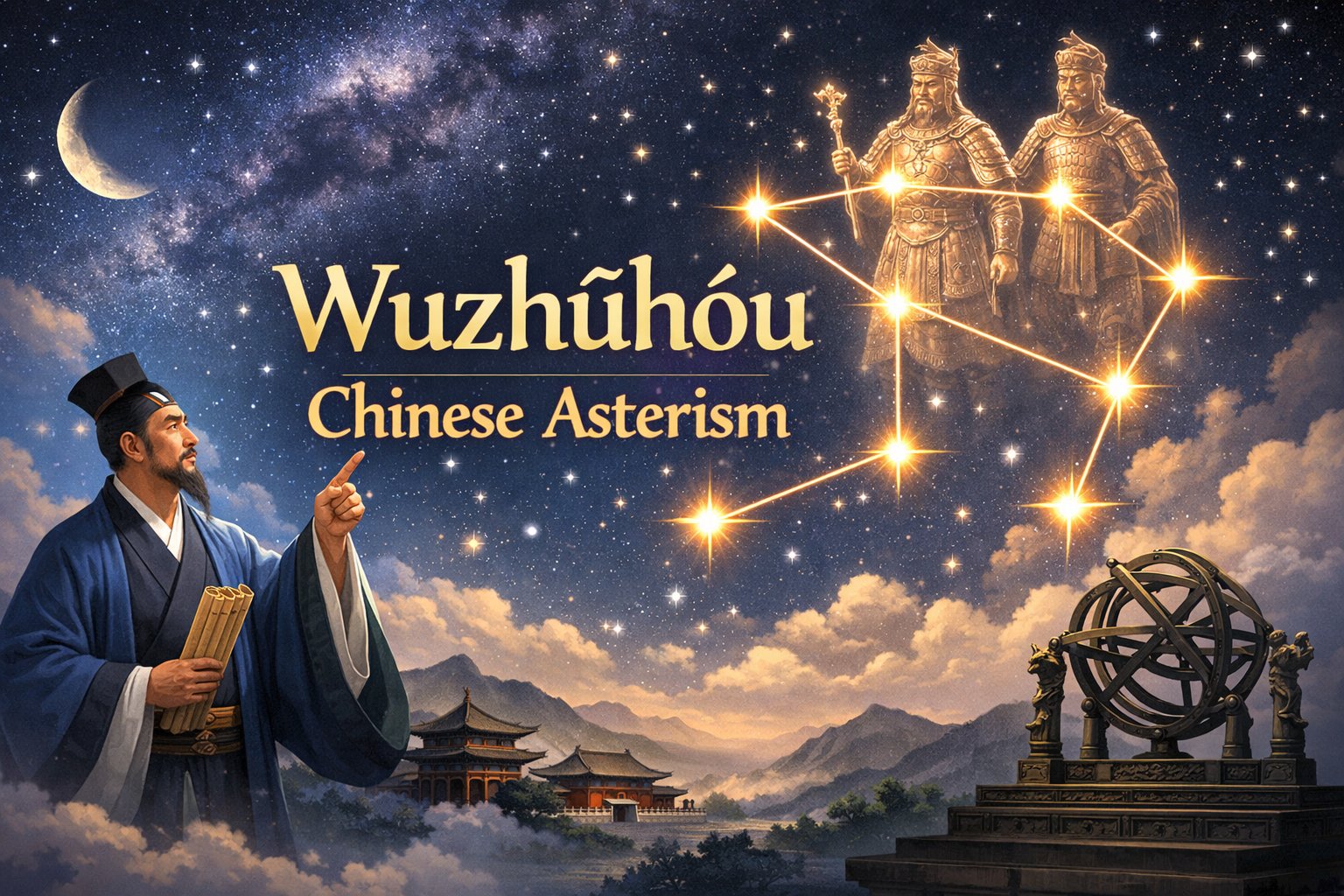
Understanding the Five Feudal Kings Asterism
The Wuzhūhóu Chinese Asterism stands as one of the most significant stellar formations in traditional Chinese astronomy. This celestial configuration, known as the Five Feudal Kings Gemini Stars, comprises five distinct stars located within the Gemini Constellation. Ancient Chinese astronomers identified these stars as powerful symbols representing the emperor’s most trusted political advisors.
Origins and Significance of the Wuzhūhóu Chinese Asterism
Political Symbolism in the Heavenly Court
The Five Feudal Kings Gemini Stars embodied the concept of five distinguished lords who functioned as essential political counselors to the emperor. These celestial advisors played crucial roles in imperial decision-making processes and maintained permanent positions within the inner court rather than governing distant territories.
Ancient Chinese astronomers assigned specific functions to this stellar formation:
- Protection against adversity: The stars served as guardians against potential troubles
- Warning system: They provided alerts about unforeseen events and disasters
- Political oversight: They governed the rise and decline of regional princes
- Astrological guidance: They offered predictive insights for imperial decisions
The Inner Court Connection
Unlike earthly feudal lords who ruled provinces, the Wuzhūhóu Chinese Asterism represented advisors who remained close to the emperor. This proximity symbolized the core political group permanently stationed within the Heavenly Court, emphasizing their importance in celestial governance.
The Five Stars: Hierarchy and Individual Roles
Complete Ranking System of the Five Feudal Kings Gemini Stars
The Five Feudal Kings Gemini Stars follow a strict hierarchical order, with each star possessing unique responsibilities and symbolic meanings:
1. θ Gem – Dishī (Imperial Tutor)
- Primary function: Oversight and guidance
- Rank: Highest among the five advisors
- Special significance: Assists the monarch in decision-making processes
2. τ Gem – Dìyǒu (Imperial Friend)
- Primary function: Military preparedness and strategic planning
- Symbolic meaning: Represents loyalty and trusted companionship
- Special role: Monitors official conduct and prevents unexpected events
3. ι Gem – Fùěr (Three Dukes)
- Primary function: Etiquette and legal systems
- Administrative role: Maintains ceremonial protocols
- Connection: Links to the Purple Palace constellation system
4. υ Gem – Bàshì (Doctor)
- Primary function: Agricultural taxation oversight
- Economic significance: Manages resource allocation
- Practical application: Influences harvest predictions
5. φ Gem – Tàishì (Grand Historian)
- Primary function: Judicial and criminal law administration
- Record-keeping role: Maintains historical documentation
- Legal authority: Oversees court proceedings
Astrological Positions and Measurements
Precise Celestial Coordinates
| Year | Star Position | Star Name | Chinese Title | Function | Orb Size |
|---|---|---|---|---|---|
|
2000-2050 |
11♋08-11♋50 | θ Gem | Dishī | Imperial Tutor | 1°40′ |
|
2000-2050 |
15♋27-16♋09 | τ Gem | Dìyǒu | Imperial Friend | 1°10′ |
|
2000-2050 |
18♋58-19♋40 | ι Gem | Fùěr | Three Dukes |
1°30′ |
| 2000-2050 | 21♋21-22♋03 | υ Gem | Bàshì | Doctor |
1°20′ |
| 2000-2050 | 25♋15-25♋57 | φ Gem | Tàishì | Grand Historian |
1°00′ |
Interpreting Omens from the Five Feudal Kings Gemini Stars
Brightness Variations and Political Implications
Ancient Chinese astrologers developed sophisticated interpretation methods for reading the Wuzhūhóu Chinese Asterism:
Positive Indicators
- Stable, bright starlight: Signifies wise governance and loyal feudal lords
- Consistent luminosity: Indicates political stability throughout the empire
- Harmonious positioning: Suggests effective collaboration between advisors
Warning Signs
- Dim or fluctuating light: Warns of potential plotting or usurpation attempts
- Irregular brightness patterns: Indicates frontier unrest or border conflicts
- Sudden darkness: Suggests imminent political upheaval
Crisis Predictions
- Abnormal brightness increases: Foreshadows rebellions within feudal territories
- Comet appearances: Signals major political transformations
- Color changes: Indicates specific types of disasters or conflicts
Detailed Analysis of Senior Advisors
Dishī – The Imperial Tutor (θ Gem)
The Imperial Tutor holds the most prestigious position among the Five Feudal Kings Gemini Stars. This celestial advisor carries dual symbolic functions that influenced both political and natural predictions.
Political Functions
- Advisory role: Provides essential guidance to the monarch
- Strategic planning: Participates in high-level deliberations
- Error correction: Assists in identifying and addressing policy mistakes
- Rank significance: Positions just below the Three Dukes in hierarchy
Disaster Prediction Capabilities
Chinese astronomers specifically associated the Imperial Tutor with flood predictions. During the Ming and Qing dynasties, court astronomers incorporated this star’s observational data into sophisticated hydrological prediction models. Changes in brightness correlated directly with major flood events, making it an essential tool for disaster preparedness.
Dìyǒu – The Emperor’s Friend (τ Gem)
The Emperor’s Friend serves multiple critical functions within the Wuzhūhóu Chinese Asterism system, focusing on protection and balance.
Core Responsibilities
- Misconduct monitoring: Tracks official behavior and reports illegal activities
- Event prevention: Guards against sudden disasters and unexpected occurrences
- Cosmic balance: Regulates the harmonious interaction between Yin and Yang forces
- Policy evaluation: Assists the emperor in analyzing governmental advantages and disadvantages
Historical Applications and Modern Relevance
Traditional Astronomical Practices
The Five Feudal Kings Gemini Stars played essential roles in Chinese imperial courts for centuries. Court astronomers regularly observed these stars to:
- Predict political stability
- Forecast natural disasters
- Guide imperial decision-making
- Assess regional governance quality
Contemporary Understanding
Modern astronomers recognize the Wuzhūhóu Chinese Asterism as an important example of cultural astronomy, demonstrating how ancient civilizations integrated celestial observations with political and social systems. These stellar interpretations provide valuable insights into traditional Chinese governance philosophy and astronomical knowledge.
Conclusion
The Wuzhūhóu Chinese Asterism represents a sophisticated integration of astronomical observation and political philosophy in ancient Chinese culture. The Five Feudal Kings Gemini Stars continue to fascinate researchers studying the intersection of astronomy, politics, and cultural beliefs in traditional Chinese society. Understanding this asterism provides deeper appreciation for the complexity and wisdom embedded in ancient Chinese astronomical traditions.