
When Science Fiction Becomes Science Fact: The Power of Literary Prophecies
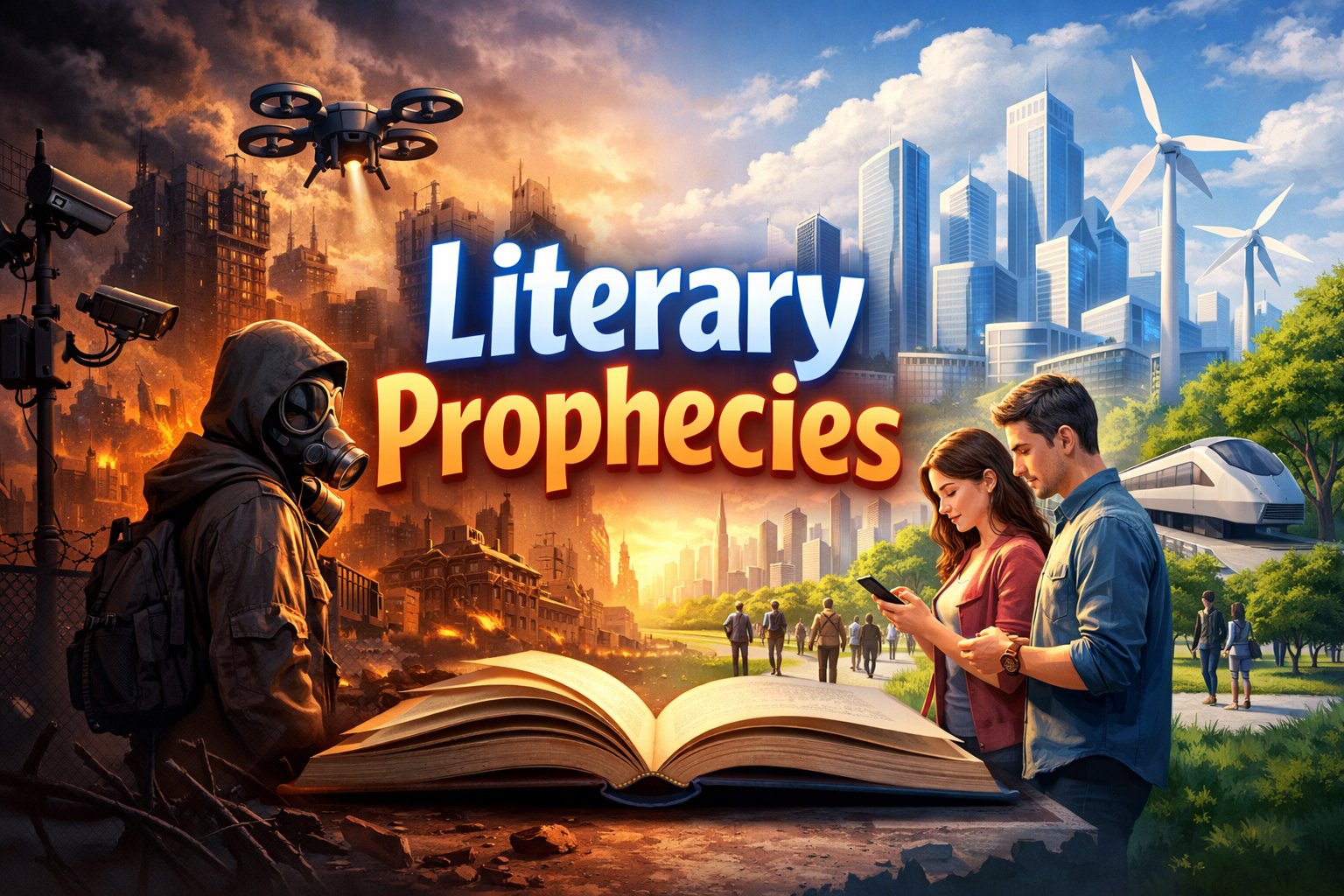
The boundaries between imagination and reality continue to blur as literary prophecies from decades past manifest in our contemporary world. From mass surveillance systems to virtual reality metaverses, today’s dystopian fiction reality demonstrates the remarkable prescience of visionary authors who anticipated our current technological and social landscape.
The Quantum Universe: Borges and the Multiverse Theory
Jorge Luis Borges: Pioneer of Infinite Possibilities
In 1941, Jorge Luis Borges crafted “The Garden of Forking Paths,” a groundbreaking narrative that would later echo quantum physics theories. This masterpiece explores an impossible novel where characters choose every possible path simultaneously, creating “a growing, dizzying web of divergent, convergent, and parallel times.”
Physicist Alberto Rojo investigated whether Borges influenced the multiverse hypothesis in quantum physics. Remarkably, when questioned about his apparent foresight, Borges denied any scientific knowledge, claiming: “Physicists are so imaginative!” This denial only strengthens the mystique surrounding literary prophecies and their uncanny ability to predict scientific breakthroughs.
H.G. Wells and Nuclear Reality
The connection between fiction and scientific development becomes even more striking with H.G. Wells’s 1914 novel “The World Set Free.” Wells depicted devastating “atomic bombs” decades before their invention. Physicist Leo Szilard read Wells’s work in 1932 and conceived the nuclear chain reaction in 1933. Szilard later admitted his fear upon realizing his theory’s implications: “I knew because I had read H.G. Wells.”
Surveillance Society: When Dystopian Fiction Reality Takes Hold
The Prophets of Surveillance
Three literary giants accurately predicted our current surveillance state:
- Yevgeny Zamyatin’s “We” (1924): Portrayed total state surveillance and the elimination of privacy
- Aldous Huxley’s “Brave New World” (1932): Explored societal control through technology and conditioning
- George Orwell’s “Nineteen Eighty-Four” (1949): Introduced concepts of omnipresent surveillance and thought control
These literary prophecies prove so relevant to our surveillance capitalism era that tech leaders appear to use them as blueprints rather than warnings. Each author envisioned ideological super-states that prohibited privacy and viewed solitude as dangerous because it encouraged independent thought.
Margaret Atwood: Contemporary Surveillance and Control
Margaret Atwood continues this tradition with “The Handmaid’s Tale” (1985), depicting mass surveillance and governmental control over women’s bodies. Her MaddAdam trilogy further explores bioengineering ethics, pandemic scenarios, and corporate monopolies—themes that resonate powerfully in today’s dystopian fiction reality.
The Digital Metaverse: Science Fiction Becomes Silicon Valley
Virtual Reality Visionaries
Two authors accurately predicted our digital future:
Neal Stephenson’s “Snow Crash” (1992) introduced the “metaverse”—an immersive virtual reality requiring headsets. In 2021, Mark Zuckerberg rebranded Facebook’s parent company as Meta, explicitly referencing Stephenson’s creation.
William Gibson’s “Neuromancer” (1984) imagined cyberspace and the Matrix, coining terms that define our digital reality. Gibson’s vision of virtual worlds connected through technology directly parallels today’s internet infrastructure.
Pre-Crime and Predictive Policing
Philip K. Dick’s Prescient Warnings
Philip K. Dick’s “The Minority Report” (1956) explored pre-crime units using psychics to predict future crimes. Dick questioned the ethics of arresting people for crimes they hadn’t yet committed. Today’s dystopian fiction reality manifests in pre-crime operations across the UK, replacing psychics with data mining, predictive algorithms, and facial recognition technology.
The Age of Kipple: Digital Overwhelm Predicted
Information Overload in Literature
Dick’s concept of “kipple” from “Do Androids Dream of Electric Sheep?” (1968) describes useless objects that inevitably accumulate and “drive out nonkipple.” This literary prophecy perfectly captures our current struggle with algorithmic content, spam emails, and digital clutter.
Dick’s first law of kipple—that useless information overwhelms valuable content—accurately predicts our information-saturated world where AI-generated content and digital noise threaten meaningful communication.
Climate Dystopia and Political Regression
Octavia E. Butler’s America
Butler’s Parable series (1993-1998) presents post-apocalyptic California where wealthy communities isolate themselves from environmental collapse. Her fictional president promises to “Make America Great Again”—a slogan that would later define real American politics. Butler’s work demonstrates how literary prophecies can capture both environmental and political regression simultaneously.
Utopian Alternatives: Imagining Better Futures
Progressive Visions in Literature
Not all literary prophecies predict doom. Begum Rokeya’s “Sultana’s Dream” (1905) envisioned a matriarchal society powered by clean electricity. Marge Piercy’s “Woman on the Edge of Time” (1976) contrasted peaceful communes with hyper-capitalist dystopias, suggesting that present actions determine future outcomes.
Why Literary Prophecies Prove So Accurate
Fiction as Social Laboratory
Dystopian fiction reality emerges because authors serve as social scientists, extrapolating current trends to their logical conclusions. They identify emerging patterns in technology, politics, and human behavior that others overlook.
These writers don’t predict the future—they examine the present so thoroughly that future developments become apparent. Their literary prophecies function as warnings, showing where current trajectories lead if left unchanged.
Learning from Literary Warnings
Preventing Dystopian Futures
As dystopian fiction reality continues manifesting around us, these literary warnings become increasingly valuable. Authors like Orwell, Atwood, and Dick didn’t write entertainment—they created cautionary tales designed to prevent the futures they depicted.
Understanding literary prophecies helps us recognize dangerous patterns before they fully develop. When tech leaders treat dystopian fiction as instruction manuals rather than warnings, literature’s prophetic power becomes essential for maintaining human agency and freedom.
The Future of Literary Prophecies
Contemporary authors continue this tradition, examining artificial intelligence, climate change, and social inequality. Their dystopian fiction reality explorations help us navigate current challenges while imagining alternative futures.
As Dick suggested, our task involves fighting “kipple”—distinguishing valuable information from digital noise while preserving human dignity in an increasingly automated world. The best literary prophecies don’t just predict the future—they help us create better ones.