
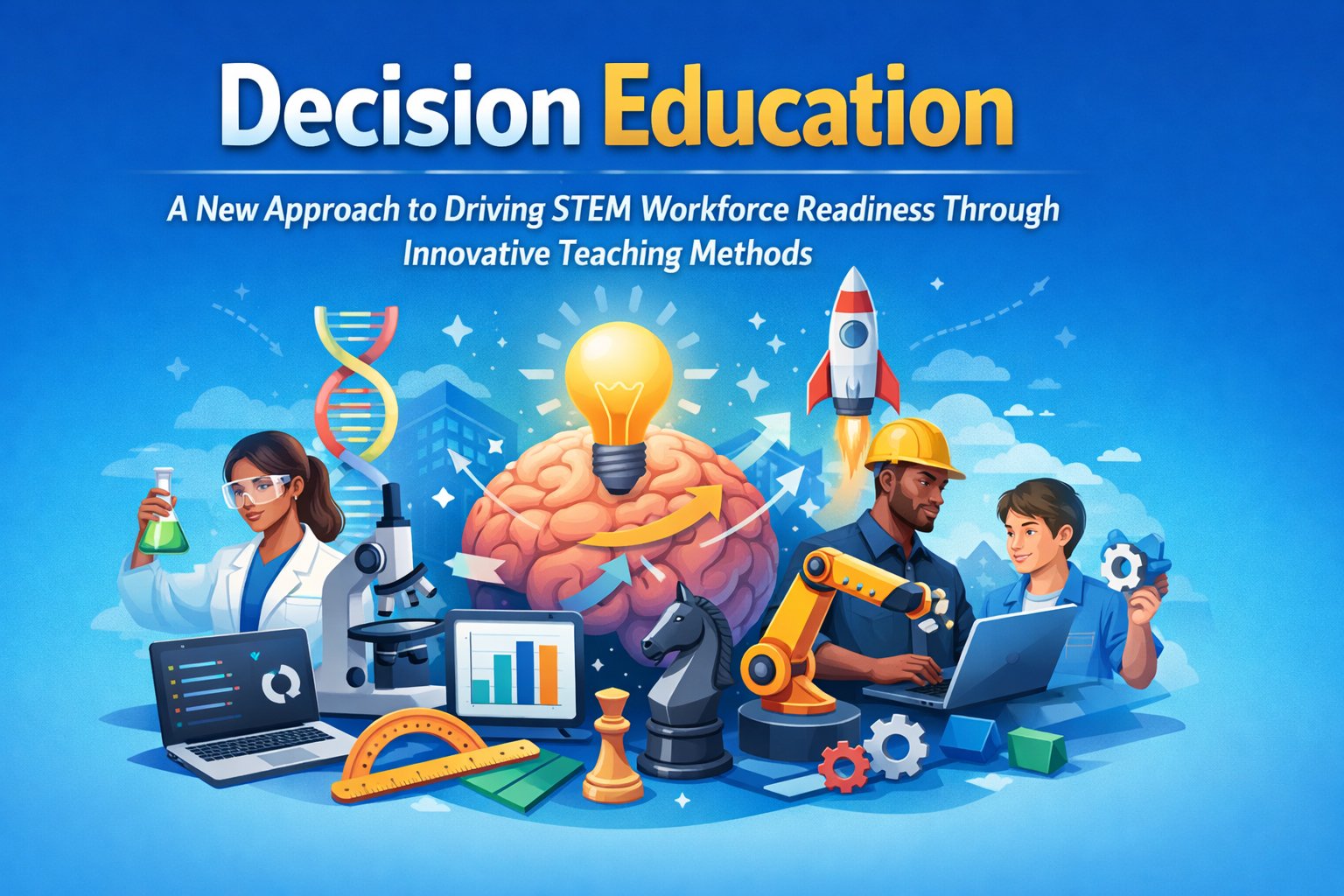
Transforming STEM Education with Decision-Making Skills
The global STEM workforce shortage presents an unprecedented challenge that educators must address today. As demand for STEM professionals increases by nearly 11 percent over the next decade, current students hold the key to solving this critical gap. These learners will drive breakthrough discoveries, tackle complex global challenges, and create innovative solutions for tomorrow’s world.
However, a significant barrier prevents many students from pursuing STEM pathways: they don’t envision themselves as future STEM professionals.
Breaking Down STEM Identity Barriers
The “I’m Not a STEM Person” Mindset
Students who experience difficulties in mathematics and science often develop limiting beliefs about their capabilities. This “I’m not a STEM person” mentality becomes a powerful obstacle that blocks students from exploring STEM careers and fundamentally alters their educational trajectories. Educators must actively combat these negative STEM identities to unlock student potential.
A Revolutionary Solution: Decision Education
Decision Education offers a promising strategy that integrates decision-making and critical thinking directly into STEM curricula. This approach equips students with essential life skills while building confidence in their ability to choose STEM career paths.
Understanding Decision Education Implementation
Seamless Integration Without Curriculum Overhaul
Educators can implement Decision Education without completely restructuring existing programs. Teachers can weave decision science theories and concepts into current lesson plans, creating a natural bridge between academic content and practical application.
Four Core Learning Domains
The Decision Education K-12 Learning Standards outline four fundamental areas:
- Thinking Probabilistically: Students learn to assess likelihood and uncertainty
- Valuing and Applying Rationality: Learners develop logical reasoning skills
- Recognizing and Resisting Cognitive Biases: Students identify mental shortcuts that affect judgment
- Structuring Decisions: Learners organize complex choices systematically
These interconnected skills enable students to gather information effectively, consider multiple perspectives, evaluate risks accurately, and apply knowledge in real-world contexts.
The Powerful Intersection of Decision Education and STEM
Strengthening Core STEM Competencies
Decision Education enhances essential STEM skills including scientific thinking, collaboration, problem-solving, and critical analysis. This innovative approach creates multiple pathways for students to engage with STEM content that aligns with their individual interests, strengths, and preferred learning styles.
Real-World Application Examples
Decision Education develops transferable skills that extend beyond the classroom. For instance, high school students can use weight-and-rate tables to evaluate college options by analyzing factors such as:
- Tuition costs and financial aid
- Academic program quality and offerings
- Geographic location and campus culture
- Career placement rates and alumni networks
While this exercise addresses personal decision-making, it reinforces analytical thinking processes that mirror STEM practices. Students learn structured decision-making, probabilistic thinking, bias recognition, and rational reasoning application.
Connecting to Scientific Practices
STEM fields require professionals to weigh variables, assess risks, and model potential outcomes. When students apply these concepts to personal choices, they recognize these skills as powerful tools for navigating daily uncertainties.
Decision Education also builds cognitive flexibility, helping students question assumptions and consider alternative perspectives. These habits prove crucial for scientific thinking, where hypothesis testing, objective evidence evaluation, and conclusion revision based on new data form the foundation of discovery.
Transforming Student Self-Perception
Building STEM Identity Through Self-Awareness
As students develop critical thinking and collaboration skills through Decision Education, they gain deeper self-awareness that can transform their relationship with STEM subjects. Students who gravitate toward literacy might reframe mathematics and science as pattern-based languages with structured communication systems.
By connecting STEM concepts to existing student strengths, educators can reshape perceptions and unlock hidden potential in learners who previously felt excluded from STEM pathways.
Strategic Implementation for Lasting Change
Essential Teacher Training and Support
Schools and districts seeking to enhance STEM education through Decision Education must prioritize comprehensive teacher training and ongoing support systems.
Professional Development Benefits
High-quality professional development programs help teachers develop the same durable skills they aim to cultivate in students. Effective training also provides opportunities for educators to examine how unconscious biases might influence their perceptions of student capabilities in advanced STEM coursework.
Addressing these patterns enables teachers to see students more clearly, strengthen empathy, and create meaningful classroom connections that support all learners.
Creating Lasting Impact Through Decision Education
Rewriting the STEM Success Narrative
When educators collaborate to make STEM more engaging and accessible through Decision Education, they accomplish more than content delivery—they fundamentally change who can succeed in STEM fields.
This new approach to driving STEM workforce readiness serves as a skill-building bridge between STEM content and students’ everyday experiences. The integration fosters:
- Increased student confidence in STEM abilities
- Enhanced curiosity about scientific concepts and applications
- Stronger sense of belonging in STEM learning environments
- Sustained motivation and engagement in STEM subjects
Universal Benefits Beyond STEM Careers
While not every student will ultimately pursue STEM careers, all learners benefit from stronger critical thinking, problem-solving, and decision-making capabilities that serve them throughout their lives.
The Path Forward: Making the Right Decision
Creating effective STEM learning environments through Decision Education requires intentional planning, shared commitment, and unwavering belief that every student deserves meaningful access to STEM education.
When schools have the opportunity to implement this transformative approach, the decision becomes clear. Every educational institution has the power to adopt Decision Education as a new approach to driving STEM workforce readiness and create lasting positive change for students and society.
The future of STEM education lies in empowering students with decision-making skills that build confidence, competence, and connection to STEM fields—ensuring a robust workforce ready to tackle tomorrow’s greatest challenges.