
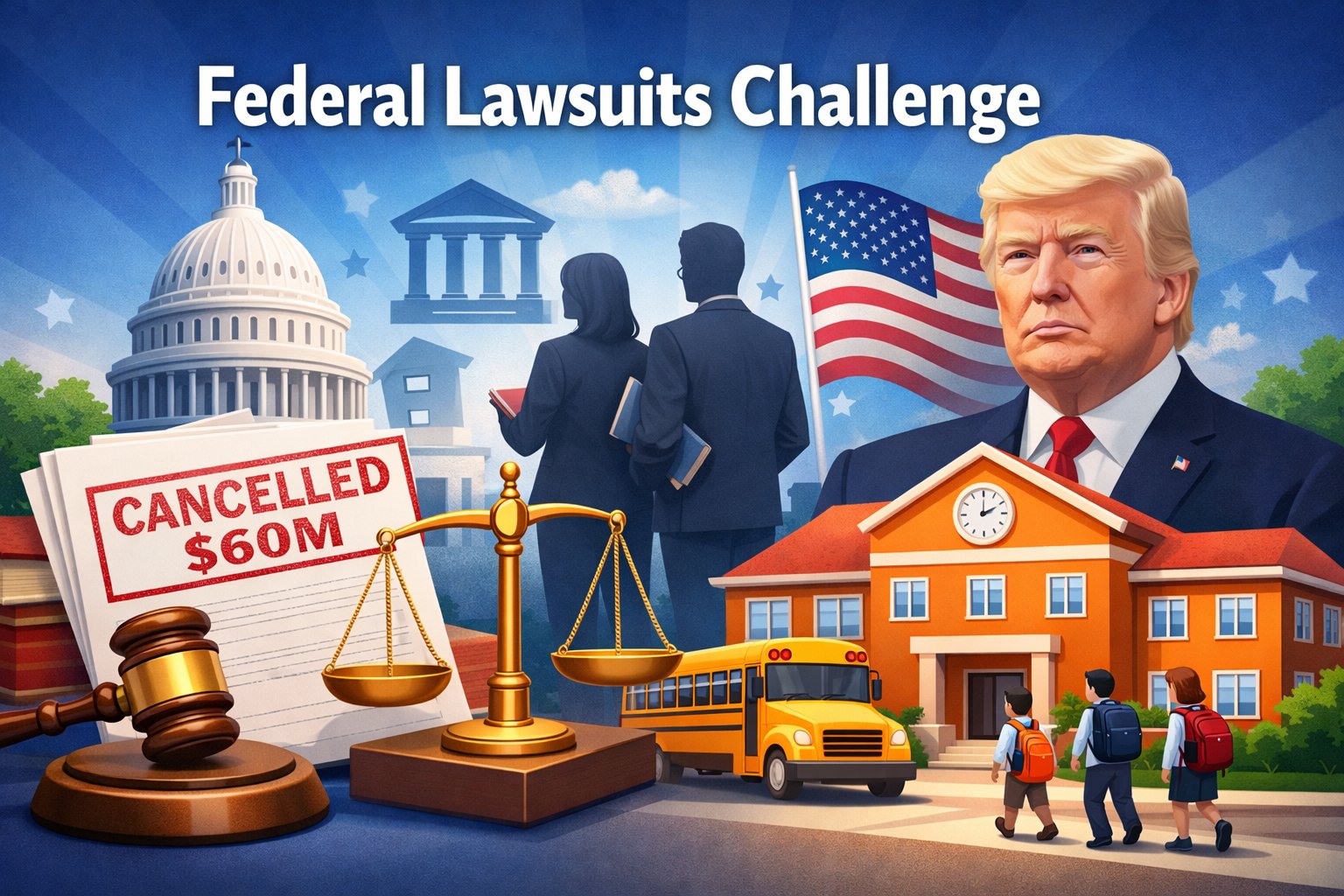
Legal Action Emerges Against Department of Education’s Grant Termination Decision
The Trump administration faces mounting legal challenges following its controversial decision to terminate $60 million in federal grants supporting community schools across K-12 education systems nationwide. Two separate lawsuits have emerged, directly challenging the Department of Education’s abrupt cancellation of these critical funding programs.
American Federation of Teachers Files Federal Lawsuit Over Grant Cancellations
The American Federation of Teachers, alongside Chicago’s Brighton Park Neighborhood Council, filed a comprehensive lawsuit on December 29, challenging the Department of Education’s December 12 decision to discontinue 19 multi-year Full-Service Community Schools grants. These lawsuits argue that the $60M cancellation of community schools grants violates federal administrative procedures and harms vulnerable student populations.
The terminated grants were scheduled to expire on December 31, but the sudden cancellation left numerous K-12 schools scrambling to maintain essential services. Brighton Park Neighborhood Council, one of the affected organizations, operates wraparound services across eight Chicago-area schools, including Curie Metro High School, where students access vital programs such as:
- STEM educational clubs
- Workforce development initiatives
- College mentoring programs
- Academic tutoring services
Patrick Brosnan, executive director of Brighton Park Neighborhood Council, expressed shock at the unexpected termination. “We hope these necessary grant funds are restored so we can continue providing needed services that help all students and families in our community achieve their goals and thrive,” Brosnan stated through Democracy Forward, the legal firm representing the plaintiffs.
State Attorneys General Challenge Federal Grant Termination
A second lawsuit emerged on December 30, filed by attorneys general from Maryland, the District of Columbia, and North Carolina. These jurisdictions were actively utilizing grants ranging from $1.9 million to $50 million when they received termination notices, disrupting ongoing five-year grant cycles.
Maryland’s experience demonstrates the real-world impact of these funding cuts. The state’s programs successfully increased attendance rates at two Baltimore high schools while providing crucial housing assistance for students in need.
Maryland Attorney General Anthony Brown condemned the decision, stating: “The Department of Education’s unlawful decision to abruptly cut funding for FSCS programs will strip hundreds of Maryland students and families of essential support for food, housing, and educational resources.”
Understanding the Full-Service Community Schools Program
The Full-Service Community Schools program represents a comprehensive approach to K-12 education support, providing federal grants to:
- Historically Black colleges and universities
- Higher education institutions
- Nonprofit organizations
- Local school districts
These grants fund diverse services including health support, social assistance, financial aid, and academic programs tailored to specific community needs. For fiscal year 2025, Congress allocated $150 million nationally for this program.
Trump Administration Justifies Grant Terminations
Madi Biedermann, deputy assistant secretary for communications at the Department of Education, defended the administration’s actions, clarifying that funding wasn’t being eliminated but redirected toward “high-quality programs that better serve special needs students.”
The administration cited policy misalignment as the primary reason for these cancellations. According to Biedermann, many discontinued programs contained elements that conflicted with Trump administration priorities, including:
Diversity, Equity, and Inclusion Concerns
The administration specifically targeted programs that emphasized:
- Staff recruitment strategies fostering diversity, equity, and inclusion (DEI) initiatives
- District equity plans covering grading, curriculum, professional development, and school climate
- Anti-racism training and culturally responsive educational practices
“The Trump Administration evaluates every federal grant to ensure alignment with our policy of prioritizing merit, fairness, and excellence in education,” Biedermann explained.
Broader Context of Educational Policy Changes
These lawsuits occur amid Education Secretary Linda McMahon’s broader efforts to restructure the Department of Education through staff reductions and budget constraints. Both McMahon and President Trump have publicly stated their ultimate goal of eliminating the Department of Education entirely.
Systematic Review of Federal Education Programs
The Trump administration has initiated comprehensive reviews of Education Department programs, specifically targeting:
- DEI-supportive activities
- LGBTQ+ educational initiatives
- Student mental health programming grants
- Deafblind student services funding
- Teacher training grant programs
This systematic approach represents a significant shift in federal education policy, moving away from programs the administration views as promoting “divisive concepts and stereotypes.”
Legal Arguments and Administrative Procedure Violations
The lawsuits challenging the $60M cancellation of community schools grants center on violations of the Administrative Procedure Act. Legal representatives argue that the Department of Education failed to follow proper procedures when terminating these K-12 education programs.
Lack of Communication and Due Process
Randi Weingarten, president of the American Federation of Teachers, criticized the administration’s approach, noting that “the Education Department did not attempt to communicate with districts or request modifications when discontinuing the Full-Service Community School grants.”
Weingarten emphasized the economic impact of these terminations, stating that “for every $1 spent on community schools, there is a $7 return on investment.” She questioned the logic behind eliminating programs that demonstrably improve achievement and attendance rates.
Impact on Rural and Low-Income Communities
The terminated grants disproportionately affect rural and low-income communities that rely heavily on federal support for comprehensive educational services. These K-12 schools often lack local resources to replace federal funding, making the sudden cancellation particularly devastating.
Educational Equity Concerns
Critics argue that the $60M cancellation of community schools grants undermines educational equity by removing support systems that help level the playing field for disadvantaged students. The Full-Service Community Schools model addresses multiple barriers to educational success, including:
- Food insecurity
- Housing instability
- Limited healthcare access
- Lack of academic support
- Insufficient extracurricular opportunities
Looking Forward: Potential Outcomes and Implications
These lawsuits represent a broader conflict over the federal government’s role in K-12 education and the extent to which political priorities should influence educational funding decisions. The legal challenges seek to restore funding and establish precedents for future grant administration.
Timeline and Legal Process
Both lawsuits request immediate injunctive relief to restore terminated funding while legal proceedings continue. The outcomes will likely influence how future administrations handle federal education grant programs and the level of discretion agencies possess in modifying or terminating approved funding.
The legal battle over the $60M cancellation of community schools grants reflects deeper tensions about educational priorities, federal oversight, and the balance between local autonomy and national standards in K-12 education. As these cases proceed through federal courts, they will shape the landscape of educational funding and policy implementation for years to come.
These lawsuits challenge not only the specific grant terminations but also the broader approach to federal education policy under the current administration, making them critical test cases for the limits of executive authority in educational governance.